Titanium card wallets and money clips: plates and screws
Titanium wallet manufacturer guide: size plates to the ISO card stack, check clip spring travel against Grade 5 yield, choose screws and finish, and write the RFQ.
A titanium card wallet or money clip is a small spring and a small stack of plates, and both are sized by arithmetic you can do before sending a drawing. The pocket has to fit a stack of ISO cards, at 0.76 mm each. The spring has to flex far enough to take them without leaving the metal permanently bent. The screws have to hold plates together without galling. This guide gives those numbers, shows how to check a clip design against the yield of Grade 5 titanium, and lists what to specify so a shop can quote a wallet or clip that works the first time.
Two families of design
Most titanium wallets and clips sold to EDC buyers follow one of three layouts:
- Plate-and-screw sandwich. Two flat titanium plates are held apart by standoffs or screws, and an elastic band or a clip holds the stack of cards. The titanium is mostly flat, so machining is cutting out the profile, drilling and finishing. The cards are retained by the band, not by the metal.
- Flexing-channel plate. One plate or a pair has channels or tabs that open to take cards and close to grip them. The metal is the spring, which makes the geometry and the yield strength critical.
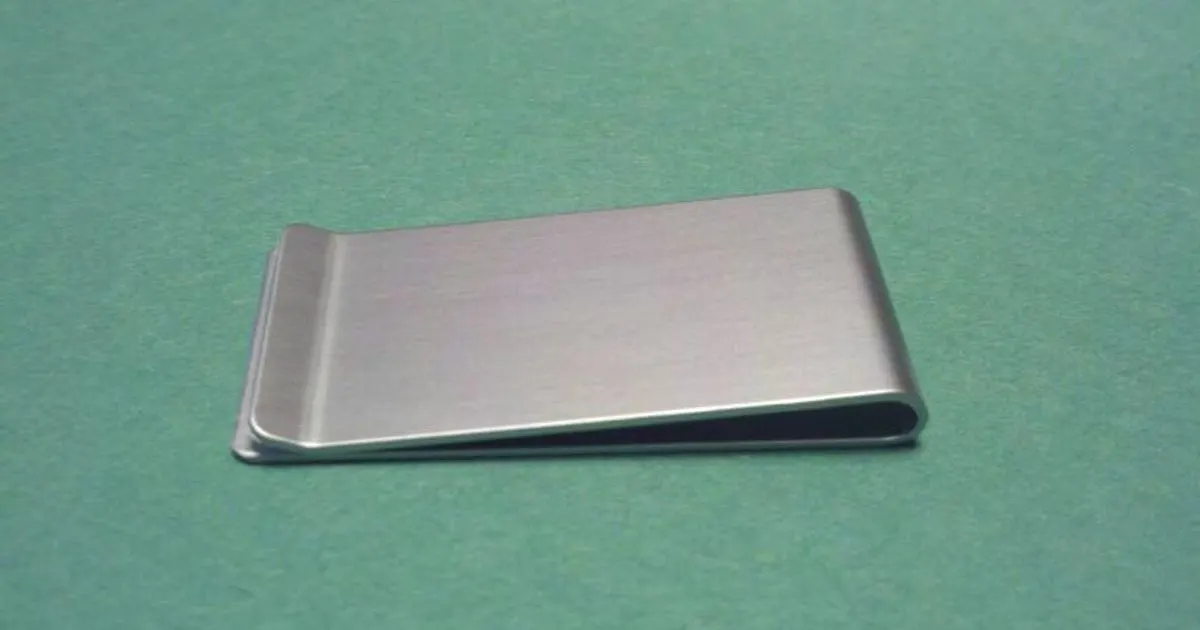
- Folded or formed clip. A flat strip is bent into a U so the two legs press the notes together. The photo above shows a folded sheet clip: the sprung gap does the gripping.
The first is the most forgiving to make. The second and third depend on the metal staying elastic through every use. Choose the family before you choose a shop, because it decides which tolerances matter.
Size the pocket to the card stack
Payment cards follow the ID-1 size in ISO/IEC 7810: 85.60 x 53.98 mm, with a thickness of 0.76 mm plus or minus 0.08 mm, and corner radii of 2.88 to 3.48 mm. A flat card stack, with no allowance for bills or for embossed numbers, then works out like this:
| Cards | Nominal stack (0.76 mm each) | Maximum stack (0.84 mm each) |
|---|---|---|
| 4 | 3.04 mm | 3.36 mm |
| 6 | 4.56 mm | 5.04 mm |
| 8 | 6.08 mm | 6.72 mm |
| 10 | 7.60 mm | 8.40 mm |
These figures are straight multiplication of the standard’s nominal and maximum thickness. Two things change them in practice. Embossed cards are thicker where the characters stand, and ISO/IEC 7811 covers that recording method, so measure your own cards rather than assuming the flat figure. And a wallet that also carries folded bills needs the stack height of the bills added. State the card count and whether embossed cards must fit in the RFQ, so the shop sets the gap between plates to suit.
Give the gap as a range, not one figure: a spacer that is a few tenths of a millimetre too tall lets cards slide out, and too short makes the wallet hard to load.
Check the spring against Grade 5 yield
Grade 5 titanium (Ti-6Al-4V) is the usual spring grade. The Ti-6Al-4V reference entry gives a tensile yield of about 880 to 920 MPa and a modulus of about 104 to 113 GPa, and lists ASTM B265 Grade 5 among its specifications. That ratio gives an elastic strain limit of around 0.8 to 0.9 percent, which is the most the surface of the metal can stretch and still spring back.
For a flat arm that flexes like a cantilever, standard beam theory (tip deflection F·L³ / 3EI, bending stress M·c / I) gives the largest tip movement that stays elastic:
δ(max) = 2 · σy · L² / (3 · E · t)
with σy yield, E modulus, L the free length of the flexing arm and t its thickness. Two examples, using the low and high ends of the ranges above:
| Arm | Free length | Thickness | Largest elastic tip movement |
|---|---|---|---|
| Thin clip arm | 40 mm | 1.6 mm | about 5.2 to 5.9 mm |
| Thick plate tab | 25 mm | 3.0 mm | about 1.1 to 1.2 mm |
These are first-pass numbers for a constant-section arm. A real design has cutouts, radii and stress concentrations, so the true limit is lower. The lesson is the scaling: the allowed movement grows with the square of the length and falls with thickness. A short, thick tab cannot flex far enough to take a stack of cards without yielding, while a longer, thinner arm can. If your design needs 2 mm of opening on a 3 mm tab only 25 mm long, the metal will take a permanent set. Design for working deflection well below the limit, and test open-and-close cycles on a prototype before committing a batch.
Grade 2, which is softer, is a poor choice for any part that has to spring. See titanium Grade 2 vs Grade 5 for EDC parts. For the same reasoning applied to a pocket clip, read pocket clips: spring temper, geometry and why they take a set.
Screws, standoffs and galling
A sandwich wallet is held by screws and standoffs, and they decide whether it rattles loose in a pocket. Points to settle with the shop:
- Thread pairing. Titanium screws in titanium plates can gall, which is the same issue covered for lights in flashlight threads that do not gall. Specify screw material and any lubricant or coating, or use a different material for one half of the pair.
- Thread formation. Small threads in titanium are often milled, not tapped, to avoid broken taps. See thread milling vs tapping small titanium threads.
- Standoff length. The standoff sets the card gap, so it carries the tolerance that matters most. Give it as a range and check it on the first article.
- Retention. Call out thread-locking or a shoulder screw if the wallet will be opened and closed often.
- Hardware style. Folding knife hardware covers screws and standoffs in detail, and the same ideas apply.
Finish, flatness and edges
Thin titanium plates can bow after machining because cutting relieves stress in the metal. Ask the shop how it holds flatness and state a flatness tolerance for the faces that touch cards. Then choose the surface: stonewash, bead blast or anodize, as in EDC finishes, with colour behaviour covered in titanium anodizing colours. Edges that touch cards need a break so they do not scratch or catch, which is the subject of tumbling, deburring and edge breaks. Say which faces are visible, as in cosmetic inspection for EDC parts.
What drives the price
The metal in a wallet is a small line. Cutting a profile from plate, drilling, finishing and inspection are the lines that move, and setup is divided over a small batch. The same arithmetic as titanium knife scale cost per piece applies, and why 25 pieces costs more than a quarter of 100 explains the curve. No public price survey exists for titanium wallets. Send one drawing to several shops and compare itemised quotes at 25, 50 and 100 pieces.
What to put in the RFQ
- Layout family and the number of cards it must hold, with any embossed or bill requirement.
- Material and condition. Grade 5 plate, with the thickness and tolerance, and any mill-certificate requirement.
- Spring geometry. Free length, thickness and the intended opening, so the shop can see what you expect it to flex.
- Fits. Gap between plates, hole positions and thread type, with critical features separated from the general block, as in tolerances and fits for knife scales.
- Hardware. Screw and standoff material, plus any lock or coating.
- Finish and cosmetic faces.
- First article. A measured sample before the batch, as in first-article inspection and CMM reports.
We are a sourcing desk, not a factory. We match your drawing to shops in the network that run small EDC batches and return itemised quotes. Send the drawing and we reply within 24 business hours.
FAQ
What size are credit cards, and how thick is a stack? Cards follow ISO/IEC 7810 ID-1: 85.60 x 53.98 mm, 0.76 mm thick with a tolerance of 0.08 mm. Six cards are about 4.56 mm nominal and 5.04 mm at the maximum. Embossed cards are thicker where the characters stand, so measure yours.
Which titanium grade should a money clip use? Grade 5 (Ti-6Al-4V), because it is strong enough to spring: about 880 to 920 MPa yield. Softer Grade 2 will take a permanent set. Whatever the grade, check the arm length and thickness against the yield, and test a prototype through repeated opening.
How do I check that a clip will not bend permanently? For a flat cantilever arm, the largest elastic movement is about 2 x yield x length squared, divided by 3 x modulus x thickness. A 40 mm arm at 1.6 mm thick gives roughly 5 mm. Real designs have stress concentrations, so keep working movement well below it.
Do titanium wallet screws gall? They can when titanium threads run in titanium. Specify the screw material and a lubricant or coating, or pair titanium with a different metal. Milled threads help in small sizes. Ask the shop how it prevents galling and confirm on the first article.
How much does a titanium wallet cost to make? No public survey exists. Cost is driven by cutting time, finishing, inspection and setup divided by the batch, and the metal is a small share. Send one drawing to several shops and compare itemised quotes at 25, 50 and 100 pieces.