Thread milling vs tapping small titanium threads
A snapped tap in a finished titanium handle scraps the part. Thread milling is slower per hole but safer. When each method fits M2 to M5 threads in EDC parts.
The worst moment in making a titanium knife handle is a tap breaking in the last threaded hole. The handle has hours of milling in it, the broken tap is harder than the part and the hole is a few millimetres wide. Thread milling and tapping both make threads. They fail in very different ways, and for small titanium holes the difference decides the price and the scrap rate.
How tapping works
A tap is a threaded cutter that is driven into a pre-drilled hole. It cuts the whole thread profile in one pass and reverses out. It is quick, often a second or two per hole, and the tool is cheap.
The problems with small taps in titanium are:
- Torque. Titanium grips the flanks of the tap. A tap in the M2 to M3 range has a small core and cannot take much torque before it twists off.
- Chips. Short chips pack into the flutes of a blind hole and jam the tap.
- Galling. Titanium smears onto the tap and tears the thread surface.
- No second chance. A broken tap is usually fatal for the part. Removing it can mean EDM or scrapping.
Shops reduce the risk with sharp taps designed for titanium, tapping fluid, a lower thread engagement and a controlled tapping cycle. They still keep a stock of spare parts for the failures.
How thread milling works
A thread mill is a small cutter that moves in a helix inside a pre-drilled hole. The CNC control cuts the thread by interpolation, usually in a single or a few revolutions. The cutter is smaller than the hole, so it does not lock in.
The benefits for titanium parts:
- Low radial force. If the tool wears or breaks, it breaks away from the thread, not inside it. A thread mill can usually be removed from the hole.
- Full threads in blind holes. The cutter can run almost to the bottom of the hole, so less drilling depth is wasted.
- One tool for many holes. A single cutter covers a range of diameters of the same pitch, and the fit can be tuned by changing the program, not the tool.
- Controlled thread fit. If the first part is a little tight, the programmer changes the offset.
The costs are time and tooling. A thread mill takes more seconds per hole than a tap, and small thread mills for M2 and below are fragile.
Where each method fits
Typical sizes in EDC parts are M2, M2.5, M3, M4 and M5, or the inch equivalents such as 2-56, 4-40 and 6-32.
- M2 and under. Thread mills are hard to find at these sizes. Many shops tap with great care or use thread forming where the material allows it.
- M2.5 to M3. The crossover. A thread mill is feasible. Titanium handles with several holes usually justify it.
- M4 and above. Thread milling is standard practice in titanium parts that are expensive or have deep holes.
A comparison table
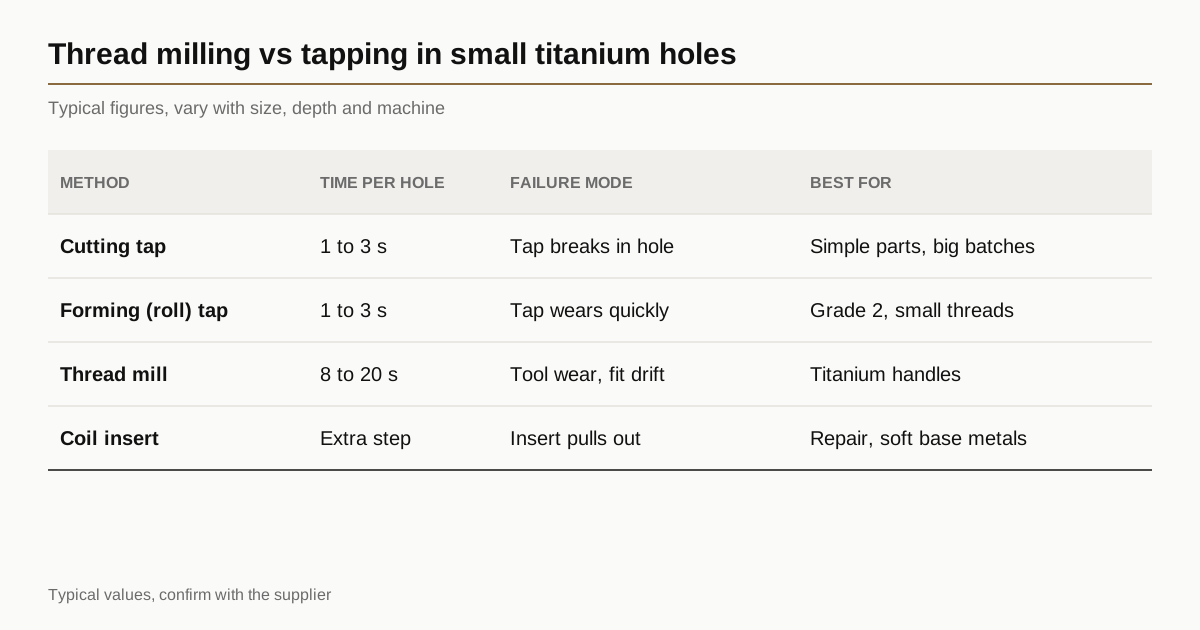
| Method | Typical time per hole | Failure mode | Best for | Watch out for |
|---|---|---|---|---|
| Cutting tap | 1 to 3 s | tap breaks in hole | simple parts, large batches | blind-hole chips, galling |
| Forming (roll) tap | 1 to 3 s | tap wears quickly | Grade 2, small tough threads | needs the larger pre-drill |
| Thread mill | 8 to 20 s | tool wear, fit drift | titanium handles, valuable parts | small-size availability |
| Insert (coil) | extra step | insert pulls out | repair or soft base metals | titanium galls on inserts |
Times are typical ranges and vary with size, depth and the machine.
Titanium-specific points
Thread engagement. A 100 percent thread is not stronger than a 65 to 75 percent thread in most titanium holes, and it is much harder to cut. Many shops drill to give about 65 to 75 percent engagement. State the minor diameter on the drawing so the shop does not guess.
Pre-drill size. Pre-drill sets how much material the tap or mill has to remove. Titanium work-hardens a little under a dull drill, so the shop should use fresh drills and avoid dwelling.
Grade. Grade 2 is softer and gummier than Grade 5. It tends to gall on the thread flank and can be harder to tap clean. See Grade 2 vs Grade 5 for EDC for the trade.
Galling between screw and hole. A steel or stainless screw in a titanium hole is a common pair. A titanium screw in a titanium hole can seize. Choose the screw material, add a thread lubricant at assembly and consider anodizing. Flashlight threads, galling and anodize allowance covers the same effect on larger threads.
Tolerance class and gauges
Internal threads in a metric part are commonly specified as 6H and external threads as 6g under ISO 261 and ISO 965. Many shops check with go and no-go thread plugs, and some add a pull test on sample parts. If a thread has to survive repeated screwdriver use, say how many cycles. A thread in titanium that sees daily service needs more engagement than one that is opened twice.
For handles and scales, check also the hole position tolerance, because the thread is only useful if the screw lines up with the part it holds. See tolerances and fits for knife scales.
Thread depth and bottoming
For a blind hole, the usable thread depth is shorter than the drilled depth. A tap leaves a few turns of incomplete thread at the bottom. A thread mill gets closer but not to zero. On a thin titanium plate the hole may be blind by design, so the drawing should state:
- Full thread depth wanted
- Drilled depth allowed
- Whether the hole can go through
What to write in the RFQ
- Thread size, pitch, class and the minor diameter allowed
- Material and grade of the part and of the mating screw
- Depth of full thread and whether the hole is blind
- Number of threaded holes per part
- Surface treatment after threading, such as anodizing
- A request for the method: thread mill or tap, and what the backup plan is for a failed hole
Send the drawing with the thread callouts and the shops in the network will reply within 24 business hours.
FAQ
Is thread milling always better than tapping in titanium? No. Tapping is faster and cheaper for large batches of simple holes. Thread milling is safer for expensive parts and blind holes.
Can M2 threads be thread milled? Some shops can, with very small cutters. Many tap M2 carefully or form the thread.
Should the thread be cut before or after anodizing? Usually before, with an allowance for the coating, or the thread is masked. Check with the anodizer.
Why do shops ask about the screw? Titanium and titanium seize easily. Knowing the screw lets the shop pick the thread class and suggest a lubricant.
What happens if a tap breaks? The shop may try to remove it, move the hole if the drawing allows it, or scrap the part. Ask who bears that cost before the order.