Titanium knife scale cost per piece: what sets the price
A titanium knife scale is priced on setup, machine time and finishing far more than on metal. How the cost per piece builds up, and what to ask for in a quote.
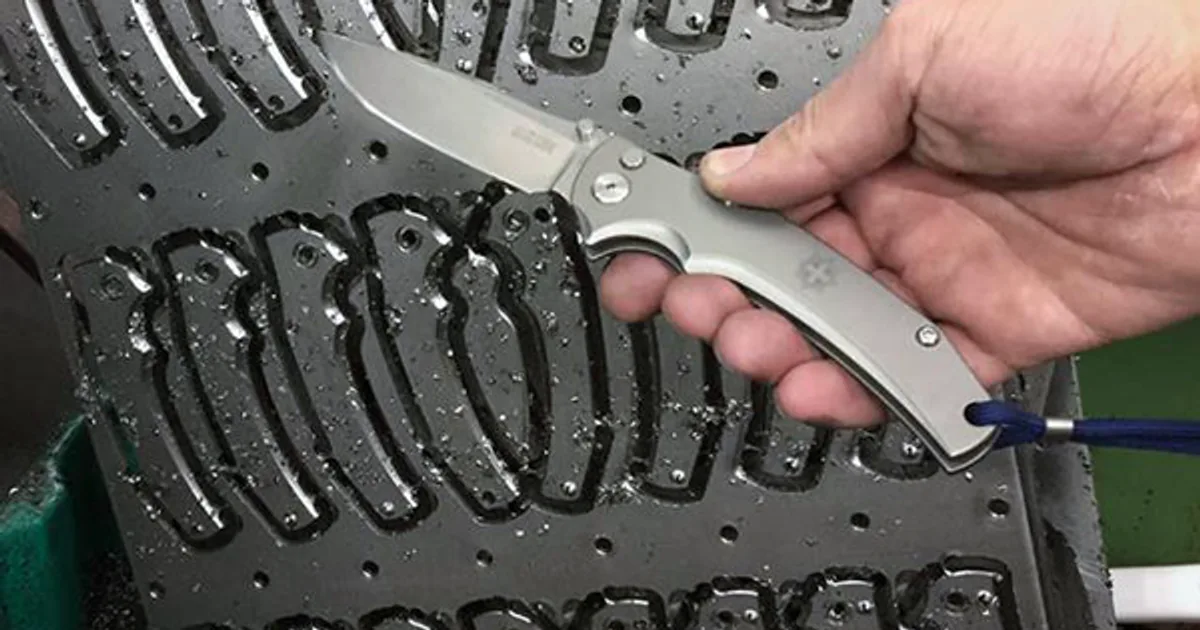
The cost of a titanium knife scale is mostly time, not metal. A scale that weighs about 70 grams as a blank holds only a few dollars of titanium at small-lot stock prices, while the programming, fixturing, cutting time, finishing and inspection are what separate a cheap quote from an expensive one. This guide breaks the per-piece price into its lines, shows how each one scales with quantity, and lists what to ask for so two quotes can be compared.
There is no public price survey for machined titanium parts, so this article gives you the structure and the arithmetic, not a number to quote against. The only way to get a real price is to send the drawing to shops and compare itemised replies.
The cost lines, in the order they usually matter
| Line | Behaves with quantity | What moves it |
|---|---|---|
| Programming and setup | Fixed per job, divided by quantity | Number of setups, fixture type, how complete the CAD is |
| Machine time | Per piece, roughly constant | Pockets, hole count, thickness, 3-axis vs 4-axis, surface finish off the tool |
| Material | Per piece, constant | Blank size, grade, stock price |
| Finishing | Per piece plus a batch minimum | Bead blast, stonewash, anodize, PVD, number of colours |
| Inspection and first article | Mostly fixed | Number of toleranced features, report requested |
| Packing, freight, duty | Per shipment | See landed cost of CNC EDC parts |
Setup is the line buyers underestimate and the one that makes small lots look expensive. The reason titanium is slow to cut is physical: Ti-6Al-4V conducts heat at only about 6.7 to 7.5 W/m·K, which the Ti-6Al-4V reference entry gives as a reason for its relatively poor machinability. The heat stays in the cutting edge, so cutting parameters are conservative and tool wear is a real cost.
Material: the smaller line than people expect
Ti-6Al-4V, ASTM Grade 5, has a density of roughly 4.43 to 4.51 g/cm³. A scale blank of 105 x 32 x 5 mm is 16.8 cm³, or about 74 g at 4.43 g/cm³. That is the figure to hold on to, because it makes stock cost easy to bound:
| Stock price | Blank cost, 105 x 32 x 5 mm | Pair of blanks |
|---|---|---|
| About $53 per kg (US retail offcuts) | about $3.94 | about $7.88 |
| $100 per kg (placeholder for a high-price case) | about $7.44 | about $14.88 |
The $53 per kg row comes from a US retailer listing Grade 5 sheet and plate offcuts at $24 per pound, which is a retail price for small pieces, not a mill price. The second row is a labelled placeholder so you can see the sensitivity, not a market quote. Titanium sponge, the raw feedstock, was reported at about $13.30 per kg in 2024 and about $12 per kg estimated for 2025 by the U.S. Geological Survey, and finished plate costs a multiple of that after melting, forging, rolling and certification. No public series tracks plate or bar prices, so ask the shop for the stock price it assumed.
Two material points that change the quote:
- Chips are most of the blank. A scale with deep lightening pockets removes a large share of the blank’s weight as chips. You pay for the whole blank, and for the time to cut the pockets, so pockets are a cost, not a saving.
- Grade. Grade 5 is stronger and slower to cut than Grade 2, and a lock-bearing scale usually needs the strength. The trade-off is in titanium Grade 2 vs Grade 5 for EDC parts.
Setup and machine time, shown without inventing a price
Shop rates vary, so here is the arithmetic with the rate left as R dollars per machine hour. The assumptions are placeholders to show the shape: 6 hours of programming and setup (inside the 4 to 10 hour range in why 25 pieces costs more than a quarter of 100) and a 20 minute cycle per scale. Replace both with the shop’s own figures.
| Quantity | Setup per piece | Cycle per piece | Machine cost per piece |
|---|---|---|---|
| 10 | 0.60 R | 0.33 R | 0.93 R |
| 25 | 0.24 R | 0.33 R | 0.57 R |
| 50 | 0.12 R | 0.33 R | 0.45 R |
| 100 | 0.06 R | 0.33 R | 0.39 R |
| 250 | 0.024 R | 0.33 R | 0.36 R |
Per-piece machine cost falls by about 40% between 10 and 25 pieces and flattens after about 100. Material, finishing and inspection do not follow the same curve, so the all-in price falls less steeply than the table suggests. That is why requesting a quote at three quantities is the most useful single thing you can do.
What drives machine time on a scale
- Setups. A scale cut from plate in one setup with soft jaws or vacuum workholding is cheaper than one flipped twice. Designing a flat datum face and keeping features on two sides to a minimum is free at CAD stage. See 4-axis vs 3-axis milling for titanium knife handles.
- Pockets and contours. Deep lightening pockets and tight internal radii force small tools and shallow passes. Opening radii to what the pocket really needs shortens the cycle.
- Thickness. Thin scales can bow under clamping and need different workholding, which is priced as a different setup.
- Hole count and countersinks. Each screw hole is a drilling, a thread or a counterbore, and in titanium a thread is slower than in aluminium. Standardising screw sizes across scales and liners cuts tool changes.
- Surface finish off the tool. A finish that needs a final light pass on the show side costs cycle time. The finishing route you choose later can hide tool marks, so do not pay twice. EDC finishes that survive a pocket compares the routes.
Finishing and inspection
Anodizing, PVD and DLC are batch processes with their own minimum charges, so a 25-piece lot often pays close to the bath minimum, and each extra colour is a separate lot. Colour also moves between lots, which is covered in titanium anodizing colours and the voltage relationship. Count rejects: a scale that fails colour or cosmetic grade is machined, finished and then scrapped, so ask whether the quote assumes a yield.
Inspection cost follows the number of toleranced features. Call out tight tolerances only on features that control fit, such as the screw hole positions and the lock-side geometry, and let the rest sit in the general block. Tolerances and fits for knife scales shows what to specify.
How to get quotes you can compare
Ask every shop for the same itemised structure:
- Setup and programming as one number, not hidden in the piece price
- Machine time per piece at 25, 50 and 100 pieces
- Material: grade, blank size, whether the stock price is in or out, and the mill test report reference
- Finishing per piece and the batch minimum, per colour
- Inspection: which report, which features
- Packing and the delivery term
If a shop will not itemise, you cannot tell which lever to pull. A quote that is 15% higher with setup and finishing split out is usually easier to improve than a low lump sum. Our notes on what buyers compare in an EDC quote cover the other side of the same exchange.
We are a sourcing desk, not a factory: we send the same drawing to shops in the network that run small EDC batches and return the quotes itemised the same way. Send a drawing with the three quantities you are considering and we reply within 24 business hours.
Sources
- Wikipedia: Ti-6Al-4V (density, thermal conductivity, ASTM Grade 5)
- U.S. Geological Survey, Mineral Commodity Summaries 2026: Titanium and Titanium Dioxide
- Tiger Titanium: Grade 5 sheet and plate offcut listing (retail, directional only)
- Wikimedia Commons: Titan fräsen Klötzli (photo, CC BY-SA 4.0)

FAQ
How much does a titanium knife scale cost per piece? There is no public price list, and it depends on quantity, pockets, finish and the shop’s rate. Metal for one 105 x 32 x 5 mm blank is only a few dollars at small-lot prices, so setup, machine time and finishing set the price. Get itemised quotes at three quantities.
Why does titanium cost more to machine than aluminium? Ti-6Al-4V conducts heat at roughly 6.7 to 7.5 W/m·K, so heat stays at the cutting edge. Cutting speeds are conservative and tools wear faster. Aluminium moves heat away in the chip and cuts much faster, which is why the same scale shape costs less in 6061.
Is Grade 2 cheaper than Grade 5 for scales? Usually somewhat, because Grade 2 cuts more easily, but the difference is small next to setup at small quantities. Grade 5 is the default where the scale carries the lock or takes screw load. Choose on function first, then compare the quotes.
Does anodizing add much to the price? It adds a per-piece charge plus a batch minimum, and every extra colour is a separate lot. A small run pays close to the minimum regardless of count, so combining colours into one finishing batch, or running fewer colours, usually saves more than negotiating the machining.
What should I give the shop to get an accurate price? A STEP file and a drawing with the alloy grade, finish, colour list, toleranced features and quantities at three levels. State the cosmetic standard for the show side. Missing information gets priced as risk, which shows up as a higher number.
Can I supply the titanium myself? Yes, but agree the blank size, the mill test report requirement and who pays for scrap. Shops may prefer to buy stock themselves because they know the blank size they can nest, so compare the quote with and without free-issue material.