Folding knife hardware: pivots, standoffs, backspacers and screws
A folding knife holds together with a dozen small turned parts. What each one does, which dimensions set the blade gap and when custom screws are worth ordering.
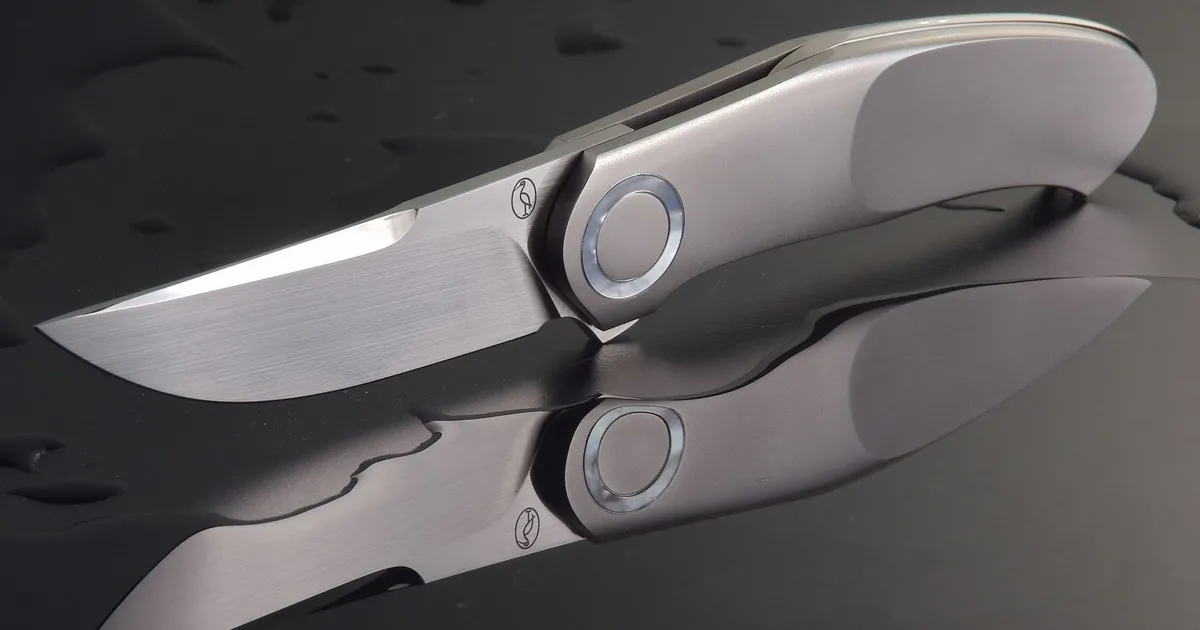
A folding knife is a few large parts, the blade and two handles, and a dozen small turned parts that hold them together and set the gaps. The small parts decide how smooth the action feels, how much the blade wobbles and whether a screw backs out in someone’s pocket. They are also the easiest parts to get wrong because each is cheap and none looks important.
The parts and their jobs
- Pivot. The axle the blade turns on. Often a pivot collar (a short sleeve) with a bolt or screw through it, so that the screw clamps the handle and the collar carries the blade.
- Pivot screw and nut. The fastener that sets pivot tension.
- Standoffs. Short spacers, often threaded at both ends, that hold the two handles apart at set distances along the knife. They set the gap in which the blade lives.
- Backspacer. A spacer at the tail of the handle that closes the gap and sets the handle thickness there. It can be a plate or a turned bar.
- Lock-bar stop pin. Limits how far a frame lock moves.
- Detent ball and its pocket. Holds the blade closed.
- Handle and clip screws. Smaller screws that join scales, liners and clip.
Washers around the pivot are a topic of their own. See knife pivot washers: phosphor bronze, PTFE and PEEK.
Which dimensions set the gap
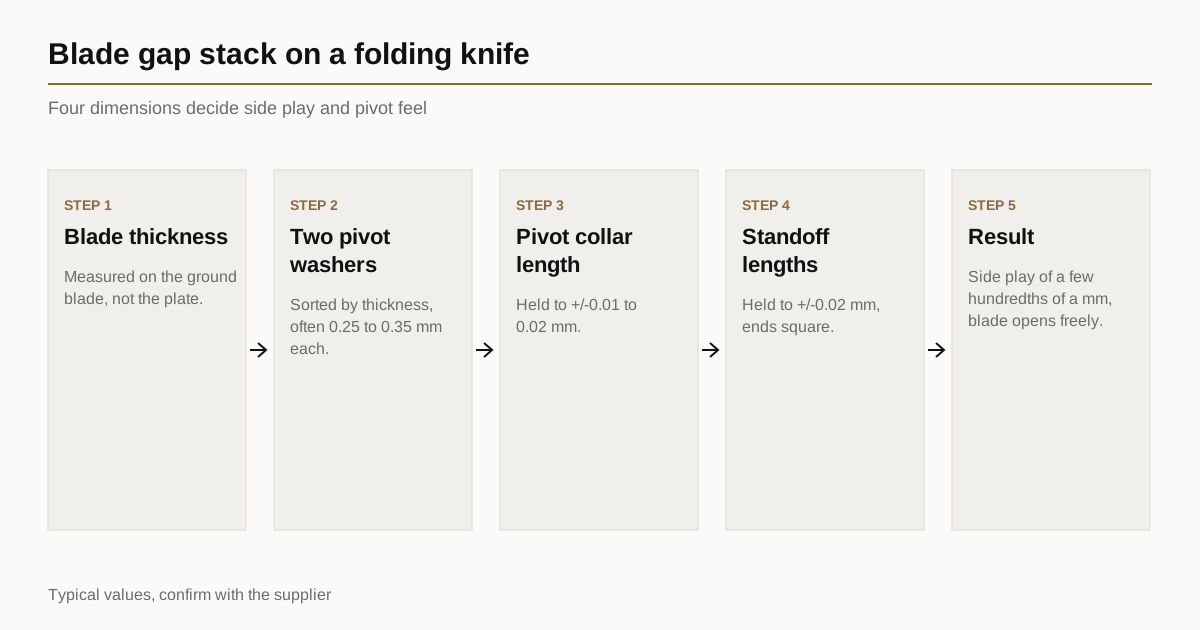
The blade gap is a stack:
- Blade thickness
- Thickness of two pivot washers
- Length of the pivot collar
- Standoff lengths on the handle
If the collar is longer than the blade plus both washers by 0.05 mm, the blade has that much side play. If it is shorter, the pivot screw clamps the blade and the knife will not open. Typical practice is a total side play of a few hundredths of a millimetre and a collar length held to ±0.01 to ±0.02 mm.
Standoff lengths matter for the same reason. A standoff 0.1 mm too long warps a handle slab when screws are tightened. Too short and the slab droops in the middle.
Typical dimensions and tolerances
These are sample ranges seen on small folders. Real values depend on the design.
| Part | Typical material | Typical size | Key tolerance |
|---|---|---|---|
| Pivot collar | stainless, titanium, 17-4 | 5 to 8 mm OD, 3 to 4 mm ID | length ±0.01 to 0.02 mm, bore H7 |
| Pivot screw | stainless, titanium | M3 or 4-40, Torx T8 | thread 6g, head seat square |
| Standoff | titanium, stainless, aluminium | 5 to 8 mm OD, 5 to 20 mm long | length ±0.02 mm, ends square |
| Backspacer | titanium, stainless, aluminium | plate or bar, 3 to 6 mm | thickness ±0.02 mm |
| Handle screw | titanium, stainless | M2.5 or M3, Torx T6 | thread 6g, head diameter |
| Stop pin | steel, titanium | 2 to 3 mm dia | diameter ±0.01 mm |
Screws and drive types
Torx, or hexalobular, drive is the standard on modern folders because it resists cam-out better than hex. ISO 10664 defines the sizes, with T6 and T8 the most common on knives. A custom head shape or a decorative head can brand the knife, but it costs more and needs a matching driver.
Thread sizes are usually M2.5, M3 or inch equivalents such as 4-40. Where the screw goes into titanium, galling is a risk. Use a thread lubricant or a retaining compound at assembly and consider a stainless or coated screw. See thread milling vs tapping small titanium threads for how the mating threads are made.
Rolled threads are stronger than cut threads, but rolling titanium is hard on tooling. Many small titanium screws use cut threads. Ask what the shop plans to use.
Material choices
- Titanium Grade 5. Light and corrosion resistant. Needs lubricant to avoid galling. See Grade 2 vs Grade 5.
- Stainless 303 or 304. Easy to machine and cheap. Soft for pivots that carry load.
- 17-4 PH stainless. Strong and wear resistant for pivot collars and pins after aging. 17-4 PH for clips and hardware explains the conditions.
- Aluminium. Light and easy to anodize in colours. Suited to standoffs and spacers but not to heavily loaded pivots.
- Brass and bronze. Smooth running, used for pivot collars and for decorative standoffs.
Pairs that rub, such as a collar against a blade, should differ in hardness or material to avoid galling.
Backspacers and standoffs in practice
Backspacers can be cut from plate with a profile milled to match the handle outline, or turned from bar as a bar spacer. A plate backspacer must be flat on both faces to within a few hundredths of a millimetre or it twists the handle. A bar spacer is easier to machine but shows as a round shape from the back.
Standoffs are turned on a lathe or a Swiss-type machine from bar. They are threaded at each end or have a through hole for a screw. Typical features are a flat face at each end, a small chamfer and a precise length. Swiss-type turning for EDC parts explains why these parts are cheap to make in quantity.
Finish
- Anodize colours aluminium and titanium hardware to match the handle.
- Bead blast or tumble for a matte look.
- Passivation for stainless parts.
Allow for coating thickness on fits. A pivot collar that is anodized grows by a few microns per side. Mask the bore or ream after coating.
Standard hardware or custom
Standard screws and spacers can be bought from catalogues in bulk. They are cheap and available, but heads, lengths and finishes are fixed. Custom hardware is made to your drawing. It costs more per piece and needs a minimum order, often several hundred pieces per part number, but it controls dimensions and brand identity.
A sensible approach for a first model is to use catalogue hardware where the exact size does not matter, such as handle screws, and custom parts for the pivot and standoffs that set the gap.
What to write in the RFQ
- Drawing for each part with the key length, diameter and tolerance
- Material and condition
- Thread callouts, thread class and drive type
- Finish and masked surfaces
- Quantities per knife and spares, plus bags labelled by part number
- A request for a sample set to test assembly
- Packing that avoids scratches
For a first order, ask the shop to build one full hardware kit and check it on a real knife before cutting the batch. Send the drawing and the shops in the network will reply within 24 business hours.
See also: folding knife components, every machined part of a folder with its material, key tolerance and route.
FAQ
What is a standoff? A short spacer that holds the two handle slabs apart at a set distance and takes the clamp load of the screws.
Why do pivot screws back out? Low thread engagement, no retaining compound or a screw that is too loose in its seat. A retaining compound is the usual fix.
Are Torx screws better than hex? Torx resists cam-out and strips less. Many knife brands choose it.
Can I mix titanium screws and titanium handles? Yes, with a lubricant. Galling is possible without it.
How many pieces are needed for custom hardware? Often a few hundred per part number. Ask each shop for its minimum.