Integral knife handles: machining from one block
An integral knife is cut from one billet, so most of the stock becomes chips. What that does to cost, scrap risk, heat treat and tolerances, and how to spec it.
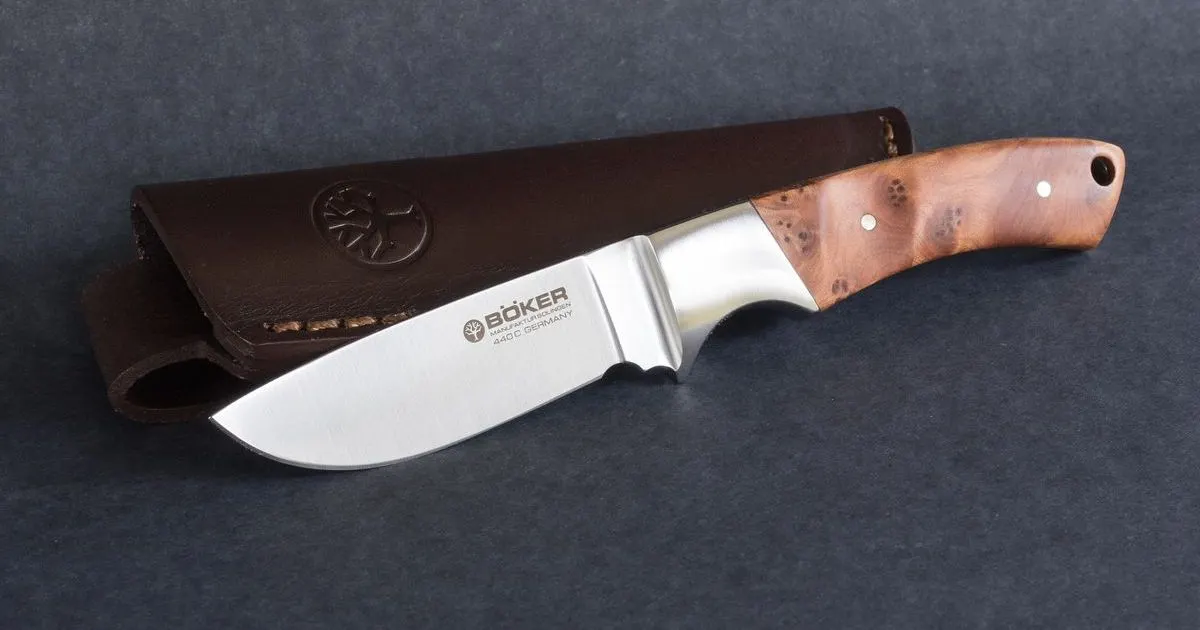
An integral knife is machined from one block of metal, so the blade, the guard or bolsters and the tang or handle are a single piece, with scales or inlays added afterward. The design removes joints between parts, but it also turns most of the starting billet into chips, and a mistake late in the process scraps the whole piece. For a brand weighing an integral against a conventional build, the question is not whether it is stronger on paper. It is what the extra machining, scrap risk and heat-treat steps do to the price per piece and to the delivery date. This guide covers the construction types, what the shop does, where cost and risk sit, and what to put in an RFQ.
What “integral” means, and what it does not
For fixed blades, integral construction means the blade, guard or bolsters, and often the butt are cut from one piece of steel. Makers differ on whether the butt counts, and a semi-integral machines only the front guard from the blade steel while the rear of the handle uses separate scales, a backspacer and screws. A full integral is machined from one billet, including the blade, front guard and rear cap.
Two other uses of the word cause confusion in RFQs:
- In folding-knife listings the word is sometimes used loosely for a handle cut from one block, so confirm what a given listing means before you copy its wording.
- “Integral lock” is a different thing: it is the name Chris Reeve gave to the frame lock, where the handle itself forms the lock bar. A frame-lock folder is not an integral knife in the one-billet sense.
Say which one you mean in the first line of the RFQ. A shop reading “integral lock” as “one-piece handle” will quote the wrong part.
What the strength claim does and does not mean
The usual selling point is strength: with no separate parts, there is no joint to fail. Makers quoted in Blade Magazine call an integral theoretically stronger, but one of them says he has never seen a standard knife break at the guard junction in regular use. Both constructions, in practical terms, produce knives that last generations. That fits what a buyer should assume. The benefit shows up mainly in hard use such as batoning or prying, and for most EDC knives the reasons to choose integral construction are appearance, fewer parts and brand story, not a measurable gain in strength.
How much of the billet becomes chips
A bar that is a couple of pounds of tool steel can finish as a knife of several ounces, as one maker in that article puts it. The ratio is what drives both machine time and material cost. As an illustration, a titanium frame blank of 110 x 30 x 14 mm is 46.2 cm³, which weighs about 205 g at the 4.43 g/cm³ low end of Ti-6Al-4V’s density range. If the finished frame weighs 45 g, the shop has removed roughly four fifths of the block. These weights are placeholders to show the shape, not a quote. The point is that stock is a smaller line than cycle time, a theme developed in titanium knife scale cost per piece.
Where the machining gets difficult
An integral knife needs deep pockets and long cutter reach, because the blade channel or the handle interior is cut from a solid block. A seller of integral knives, Urban EDC, says full integrals typically need five-axis CNC machines to carve the blade channel and handle from solid stock. Treat that as a vendor view, because 3+2 or 4-axis setups can also do it for simpler shapes.
The physics is simple. Harvey Performance notes that tool deflection increases as overhang increases, and recommends the shortest reach on the largest diameter tool that fits. Beam theory gives a tip deflection proportional to the cube of the free length for a given force, so doubling the stick-out of the same cutter multiplies its deflection by eight. That is why internal corner radii in deep pockets are a quoting issue: a small radius forces a thin tool with long reach, which then cuts lightly and slowly.
Practical design points:
- Call out the largest internal radius the design can accept in every pocket. A radius that is a little larger than the cutter allows a stiffer tool.
- Limit pocket depth relative to width where you can. Make a deep channel two shallower steps if the geometry allows.
- Allow access for the finishing tool. A feature that only a very small cutter can reach will add hours.
- Separate cosmetic from functional faces. Say which surfaces are visible, as in cosmetic inspection for EDC parts.
See also design for CNC: seven changes that cut an EDC quote and 4-axis vs 3-axis milling for titanium knife handles.
Heat treatment changes the plan for steel
A titanium integral frame has no hardening step. A steel integral blade does, and the whole piece is heat treated. A few hundredths of a millimetre of distortion during hardening is normal, so a steel integral is usually rough machined, heat treated, then finish ground, with the order set so that critical faces get their final cut after the part has moved. Heat treatment for EDC parts covers the sequence and the one to two weeks it typically adds. Because the whole billet goes through the furnace, a failed or warped piece costs all the machining done before it.
Construction types compared
| Construction | Parts | Machining and risk | Serviceability | Typical use |
|---|---|---|---|---|
| Full integral, fixed blade | Blade, guard and tang in one piece, plus scales | Highest stock removal, whole billet at risk, heat treat then finish grind | Few adjustments, scales replaceable | Premium fixed blades |
| Semi-integral | Front guard from the blade steel, separate rear parts | Lower scrap risk, rear hardware corrects small errors | Pivot-style adjustments still possible | Mid-to-high price tier |
| Standard stock-removal blade with separate guard | Blade, guard, scales as separate parts | Lowest machining per part, assembly needed | Parts can be swapped | Volume and mid range |
| One-billet folding handle | Handle machined with blade channel, hardware separate | Deep pockets, titanium or aluminium, no heat treat for the handle | Hardware adjusts pivot | Premium folders |
Urban EDC notes that full integrals offer little adjustability, so fixing blade centering can mean custom-machined washers, and that a small error can ruin the whole billet. That seller promotes its own integral models, so read its framing with that in mind. For washers, see knife pivot washers, and for the hardware that holds a folder together, folding knife hardware: pivots, standoffs, backspacers and screws.
What to put in the RFQ
- Construction type and the drawing set. A full model plus 2D drawings with the critical features called out. Use STEP, IGES, DWG, DXF: which CAD file to send.
- Material and condition. Grade, bar or billet size you will accept, and hardness range if steel.
- Critical tolerances only. Pivot bore, lock face, blade centering reference. Leave the rest to the general block, as in tolerances and fits for knife scales.
- Radii and access. The largest internal radius allowed in each pocket.
- Finish. Stonewash, bead blast or anodize, using EDC finishes as the reference, and which surfaces matter cosmetically.
- First article. Ask for a measured first piece before the batch, as in first-article inspection and CMM reports.
- Scrap policy. Ask each shop how it prices spoiled pieces: in the unit price, or charged back to you. State that you want the answer in writing.
At small quantities, ask for the price at 10, 25 and 50 pieces. Why 25 pieces costs more than a quarter of 100 explains why the curve is steep.
We are a sourcing desk, not a factory. We match your drawing to shops in the network that run small EDC batches and return itemised quotes that show setup, per-piece time, finish and scrap treatment separately. Send the drawing and we reply within 24 business hours.
FAQ
What is an integral knife? An integral knife has its blade, guard or bolsters and tang or handle cut from a single piece of metal, with only scales or inlays added. Makers differ on whether the butt counts, and semi-integral designs machine only the front guard from the blade steel.
Is an integral knife stronger? In theory yes, because there are no joints. Makers interviewed by Blade Magazine say standard knives rarely break at the guard junction in regular use, so the advantage mainly matters for hard use such as batoning or prying. Choose integral for design reasons first.
Why do integral knives cost more? Most of the billet is machined away, so cycle time is long, long-reach cutters work slowly and a late error scraps the whole piece. Steel integrals add heat treatment and finish grinding. Ask each shop to show setup, per-piece time, finish and scrap treatment as separate lines.
Is an integral lock the same as an integral knife? No. The Reeve Integral Lock is a frame lock, where the handle forms the lock bar. An integral knife is made from one billet. State which one you mean in the RFQ so the shop quotes the right part.
Can integral knives be made in small batches? Yes, but setup is spread over few pieces, so unit price drops sharply with quantity. Ask for prices at several quantities, and approve a measured first article before the batch.