Knife pivot washers: phosphor bronze, PTFE and PEEK compared
Pivot washers set how a folder opens, yet cost cents each. Phosphor bronze, PTFE and PEEK differ in feel, wear and tolerance needs. What to specify and what to test.
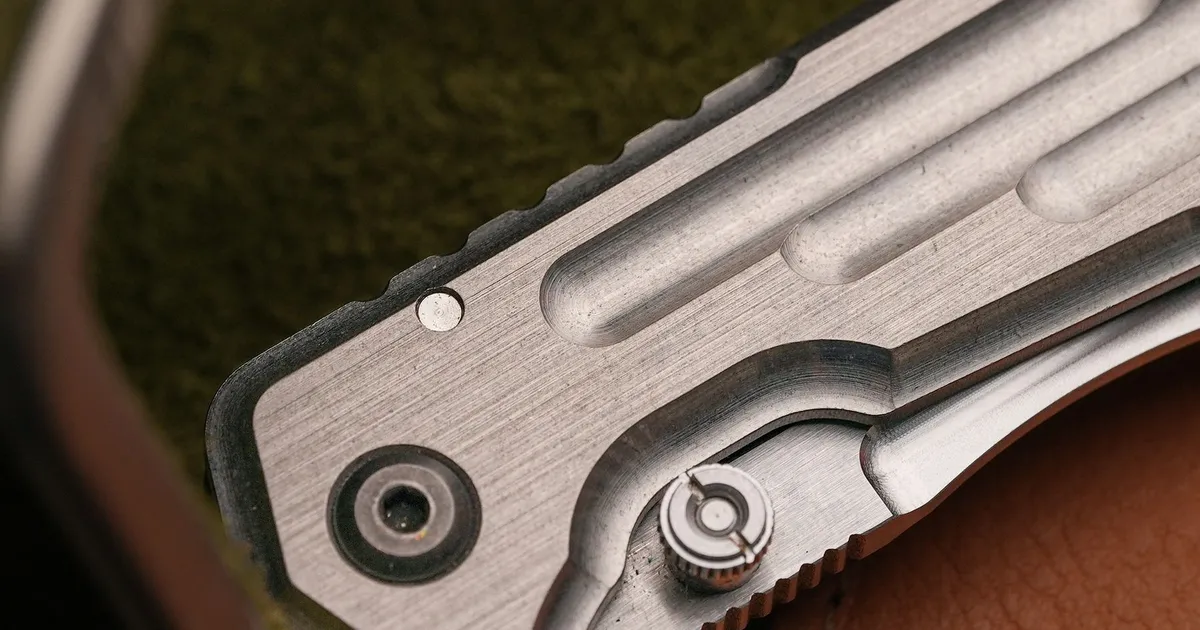
A knife pivot washer is a thin disc between the blade and the handle. It costs a few cents and decides whether a folder opens with a smooth glide or a gritty scrape. Buyers feel it in the first flick, which makes washers one of the cheapest places to win or lose a good review.
What the washer does
On a folding knife, the blade rotates on the pivot screw or pin. A washer on each side of the blade keeps the blade from touching the handle scales or liners directly. Without it, metal rubs on metal, the action feels rough and the faces wear.
The washer also sets the blade’s side play. Together with the pivot screw tension, its thickness decides whether the blade wobbles side to side or binds. A washer thickness error of 0.05 mm can be the difference between a smooth knife and a stiff one.
The three common materials
Phosphor bronze
Phosphor bronze is a copper-tin alloy with a small amount of phosphorus, commonly sold as UNS C51000 or similar. It is hard enough to stand up to years of use, smooth against steel and titanium and takes a thin film of oil well.
- Feel. A solid, smooth glide with a slight weight. Many collectors associate it with a high-quality manual folder.
- Wear. Low. The washer lasts through years of use with periodic oiling.
- Maintenance. Needs a drop of oil. Left dry, it can feel sticky and squeal.
- Cost. Low in the metal, a bit more for precision stamping or turning.
PTFE
PTFE is a very low-friction plastic. It slides easily with no oil, which suits knives that may be carried in damp or dusty conditions and rarely maintained.
- Feel. Very smooth at first, sometimes slightly spongy.
- Wear. The material is soft and tends to creep under load. Washers can thin or deform over time, which loosens the pivot.
- Maintenance. None, but the pivot may need re-tightening.
- Cost. Low. Often used in budget knives.
PEEK
PEEK is a hard, high-performance plastic with low friction, good wear resistance and strength at temperature. It is stiffer than PTFE and resists creep much better.
- Feel. Smooth and firm. Sometimes a little less buttery than bronze, depending on the finish.
- Wear. Good, with less thinning than PTFE.
- Maintenance. Low. A light lubricant helps feel.
- Cost. Higher than PTFE and often higher than bronze for the raw material, but small parts keep the unit price modest.
Other options exist, such as POM (acetal), nylon and ball bearing pivots, but these three are the usual quotes.
A comparison table
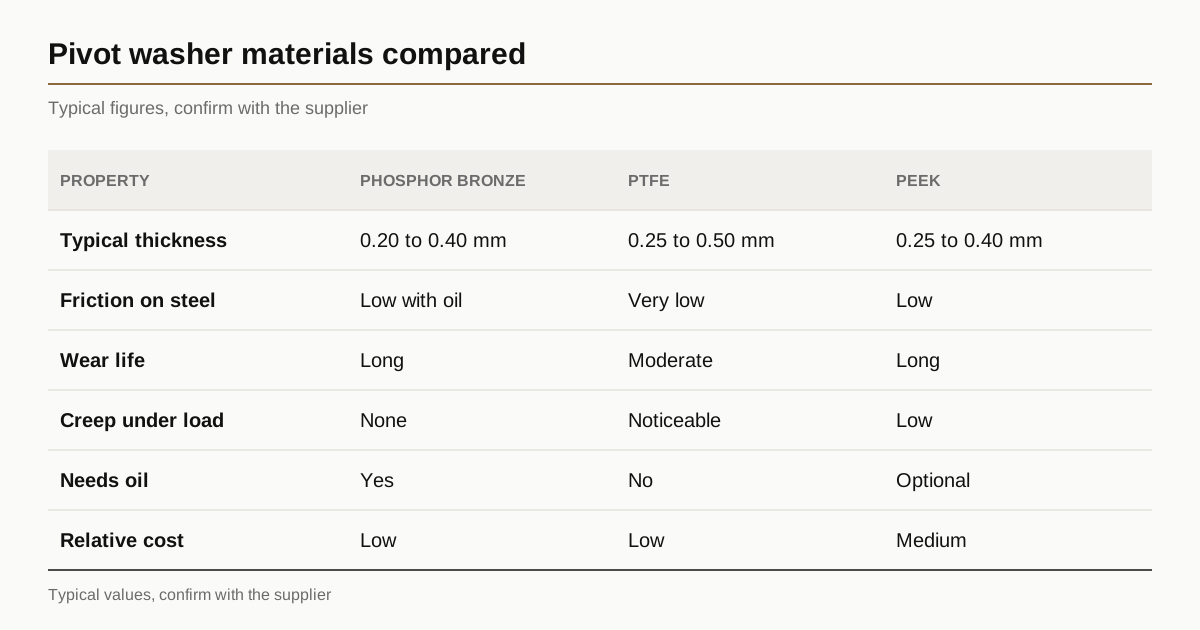
Typical figures, for comparison. Confirm with the supplier.
| Property | Phosphor bronze | PTFE | PEEK |
|---|---|---|---|
| Typical thickness | 0.20 to 0.40 mm | 0.25 to 0.50 mm | 0.25 to 0.40 mm |
| Friction against steel | low with oil | very low | low |
| Wear life | long | moderate | long |
| Creep under load | none | noticeable | low |
| Needs oil | yes | no | optional |
| Machining or cutting | stamp or laser, turn | punch or cut | cut or machine, care with burrs |
| Relative cost per piece | low | low | medium |
Tolerances that matter
For a washer, the number that matters most is thickness. A few hundredths of a millimetre of variation changes pivot feel. Specify:
- Thickness tolerance. For example ±0.02 mm, tighter if the knife is fine-tuned by hand.
- Flatness. A washer that is curved or wavy produces uneven friction.
- Inner and outer diameter. Match to the pivot and the handle recess.
- Surface condition. Burr-free, with the cut edge smooth. Lapped or polished faces improve feel.
- Parallelism of the two faces.
For plastics, add a note on temperature and moisture. PTFE and PEEK change dimensions slightly with temperature, and PEEK can absorb a little moisture. The effect is small but not zero.
How washers are made
- Phosphor bronze. Cut from strip by stamping or by laser, and sometimes turned from rod. Stamping is cheap at 1,000 pieces and above. Laser cutting suits small runs. Post-processing such as deburring and lapping affects the feel.
- PTFE. Punched or cut from sheet and sometimes skived from a cylinder.
- PEEK. Cut from sheet or machined. It leaves burrs that must be removed.
Washers are bought in bulk and should be counted and bagged by spec. Keep spares, as they are consumables.
Thickness steps for fine tuning
Many makers buy washers in two or three thicknesses, for example 0.25, 0.30 and 0.35 mm, and pick the pair that gives the right side play on each knife after assembly. This turns a tolerance stack problem into a simple sorting job at the bench. If you plan to do this, order washers in labelled bags by thickness and check each lot with a micrometer when it arrives.
Matching washer to knife design
- Thumb stud and slip joint openers like bronze for a deliberate, smooth motion.
- Flippers need very low friction and consistent thickness. Many use PEEK or bronze with bearings.
- Frame lock knives with titanium handles can run any of the three. Pay attention to galling between titanium and steel at the pivot.
- Budget folders often use PTFE for cost and low maintenance.
Tolerances and fits for knife scales explains the stack of dimensions around the pivot, and custom knife pivot screws, standoffs and backspacers covers the hardware around the washers.
Testing washers
Make a small test knife or use first articles to compare materials:
- Open and close 500 times and measure change in pivot play.
- Dust or sand test if the knife will be used outdoors.
- Oil and dry test to see how each behaves without maintenance.
- Temperature test for plastics if the knife may be left in a car.
Record the results with photos. The first article report is the place for them.
What to write in the RFQ
- Material and standard, for example phosphor bronze UNS C51000
- Thickness and tolerance, flatness and surface requirement
- Inner and outer diameter with tolerance
- Quantity of washers per knife and spares
- Packing: counted bags, labelled by thickness
- Samples of two materials for comparison, if allowed
Send the drawing with the washer specification and the shops in the network will reply within 24 business hours.
FAQ
Which pivot washer material is best? It depends on the knife. Bronze suits a classic smooth feel with oiling. PTFE suits low maintenance. PEEK suits a firm, low-creep action.
Do I need to oil PTFE or PEEK washers? PTFE does not need oil. PEEK benefits from a light lubricant but works dry.
Why does my pivot loosen over time? Soft washers such as PTFE creep under load. Thicker or harder washers and thread locker on the screw reduce it.
How many washers per knife? Usually two, one each side of the blade. Some designs use a bearing instead.
Can I mix materials? Yes, but test the combination. Different washers on each side can cause a lopsided feel.