4-axis vs 3-axis milling for titanium knife handles
A flat handle slab is a 3-axis job. Rounded edges, contoured backs and tight batches push it toward 4-axis. What changes in setups, cycle time and cost.
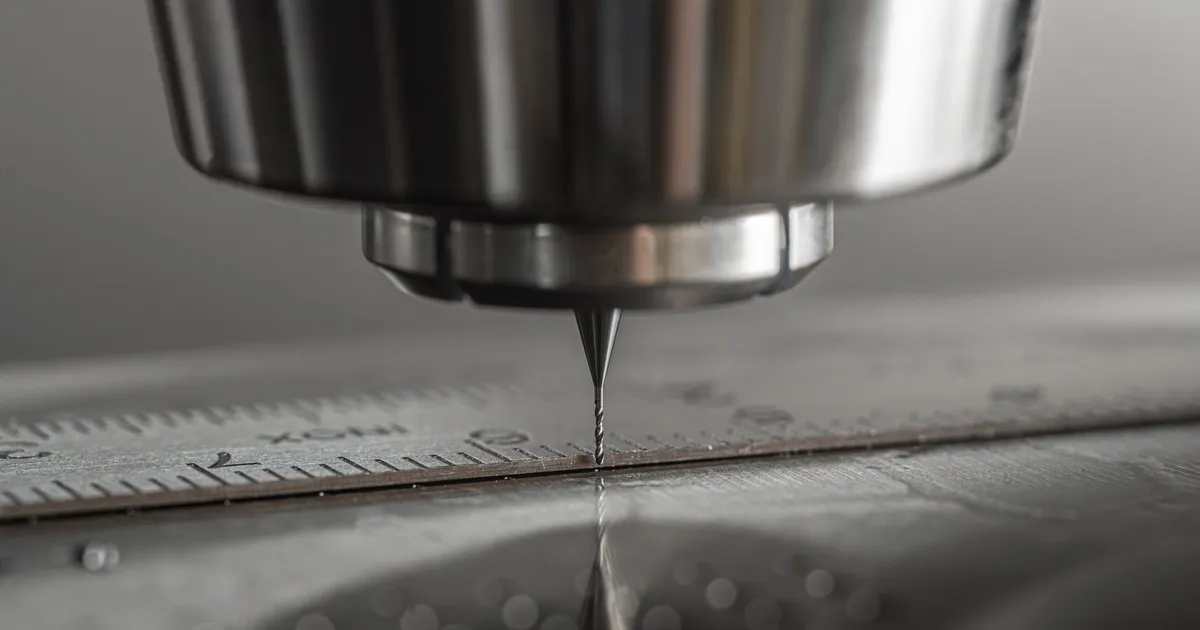
Most titanium knife handles start as a flat plate and finish as a contoured slab with pockets, a pivot area and rounded edges. Whether that happens on a 3-axis or a 4-axis machine changes the number of setups, the cost of fixtures and how well the left and right sides match.
What the extra axis does
A 3-axis mill moves the tool in X, Y and Z. The workpiece sits still in a vise or on a fixture plate. To reach the back of the handle, an operator unclamps it, flips it and finds the position again.
A 4-axis machine adds a rotary axis, usually called A, that turns the workpiece around a horizontal line. There are two ways to use it:
- Indexing (3+1). The table rotates to a set angle, locks, and the tool cuts as on a 3-axis mill. This reaches the edges and the back without releasing the part.
- Simultaneous 4-axis. The rotary axis moves while the tool cuts, which makes smooth wrapped contours possible.
The rotary axis is useful when the handle is cut from bar or when several handles are mounted around a tombstone fixture so the spindle can work on many sides without stopping.
Handles are mostly 2.5D work
A typical frame-lock handle is a plate of Grade 5 titanium, often somewhere between 3 and 6 mm thick. Most of its features are pockets, through cuts, counterbores and a lockbar relief, all cut straight down. That is why a 3-axis machine does a large share of the work well.
The areas that bring the extra axis into play are these:
- Rounded or chamfered edges that run around the handle outline
- Contoured backs and bellies where the thickness changes smoothly
- Handles cut from round or oval bar where the outer surface is itself a curve
- Both sides of the part in one clamping so that pivot holes line up
Setups and what they cost
Every setup costs fixture time, a probing or indicating step and a risk of misalignment. Titanium makes it worse, because a thin plate relaxes when material is removed from one side and the part can bow before it is flipped.
A common 3-axis route for a pair of handles:
- Rough both faces with stock left on, leaving the part held by small tabs.
- Finish the first face and drill the pivot and screw holes.
- Flip on a pin fixture and finish the second face.
- Remove the tabs, deburr and chamfer the edges.
On 4-axis the shop can often combine steps 2 and 3, and run the edge chamfer in the same cycle. The fixture is more expensive and the program is longer, but there is one less handling step per part.
A comparison table
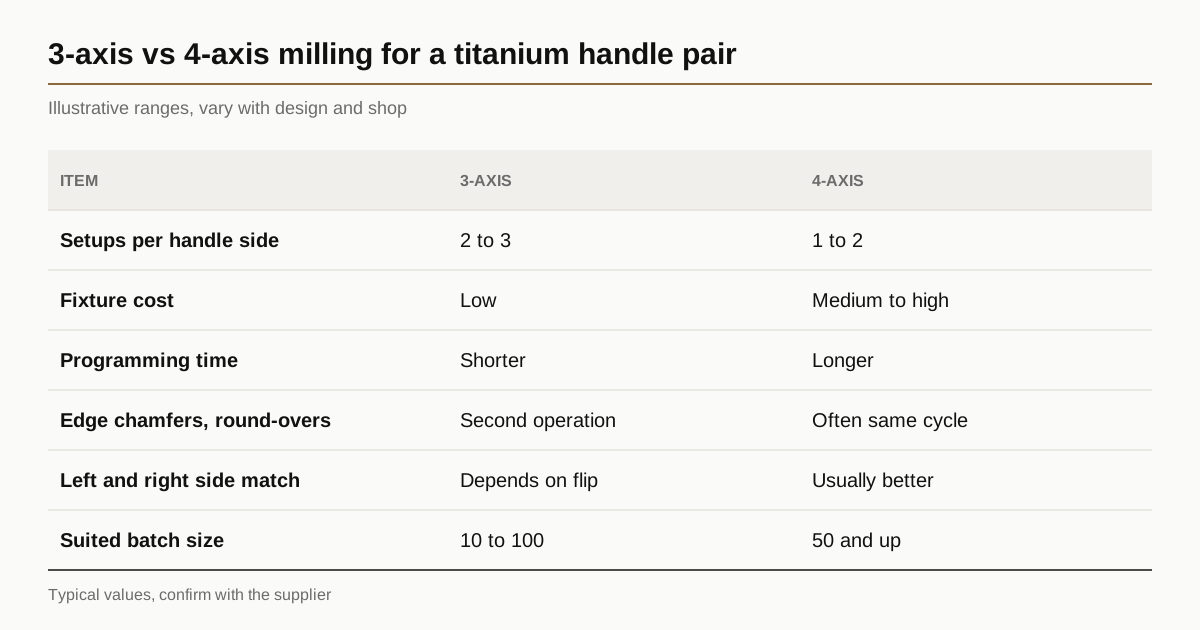
Figures below are illustrative ranges seen on quotes for handle pairs. They move with design, batch size and the shop. Treat them as a starting point for a conversation.
| Item | 3-axis | 4-axis |
|---|---|---|
| Setups per handle side | 2 to 3 | 1 to 2 |
| Fixture cost | low | medium to high |
| Programming time | shorter | longer |
| Edge chamfers and round-overs | second operation or ball-end passes | often in the same cycle |
| Left and right side match | depends on flip accuracy | usually better |
| Suited to batch size | 10 to 100 | 50 and up |
Titanium changes the numbers
Grade 5 titanium cuts at a fraction of the surface speed of aluminium, and heat stays at the tool edge. Shops use sharp carbide tools, steady coolant, low radial engagement and tool paths that avoid dwelling in one place. Cycle time is therefore long even when the geometry is simple.
On thin walls such as a lockbar the biggest risk is chatter. A 4-axis fixture that supports the part from several sides can help, but a 3-axis shop with good workholding can also do it. The decision should rest on the part, not on the machine label.
Where 5-axis comes in
Sculpted handles with compound curves, such as a hand-shaped swell that changes in two directions at once, are the territory of 5-axis machines. Those parts cost more per hour on the machine but may need fewer setups and hold the surface better. For a flat slab with a chamfered edge, 5-axis is more machine than the job needs.
Cosmetic points to agree before quoting
- Scallop height. On a contoured surface the tool leaves tiny ridges between passes. A finer step-over cuts them down and adds time. Say whether the surface will be bead blasted or stonewashed afterwards, because the finish hides some of it. See finishes: stonewash, bead blast and anodize.
- Edge breaks. Define the chamfer size in the drawing and not just “break edges”.
- Witness marks. Tab removal leaves a small mark. Agree where it may be.
Tolerances that matter on handles
The numbers that decide whether the knife assembles are the pivot hole position, the standoff hole positions and the flatness of the mating faces. Everything cosmetic can be corrected later. Hole position cannot. For fit and tolerance guidance, tolerances and fits for knife scales goes through what to call out.
How to choose for a first run
For a first batch of twenty to fifty pairs, ask for a 3-axis quote and a 4-axis quote side by side. The 3-axis price tells you the floor for the fixture cost. The 4-axis price shows what you save in handling once the batch grows. If the two are within about fifteen percent, pick the one with fewer setups, because it will repeat better on the reorder and cost less to correct if the design changes.
What to write in the RFQ
- Drawing with the thickness, outline and every hole position dimensioned from one datum
- Material and condition, for example Grade 5 annealed
- Number of handle pairs and the expected reorder
- Surface to be finished afterwards, such as bead blast or anodize
- Which edges need a chamfer and its size
- Whether handles are sold as left and right pairs
Ask the shop to say how many setups it plans and whether it will use a 3-axis or 4-axis machine. A good answer shows the quote has been thought through. When you are ready, send the drawing and the shops in the network will reply within 24 business hours.
FAQ
Is 4-axis always more expensive per part? No. Machine hours cost more and fixtures cost more, but fewer setups and less hand work can lower the unit price from about fifty pairs upward.
Can a 3-axis machine produce a rounded edge? Yes, with a ball-end or chamfer tool in a separate pass. It takes more time and the surface needs more finishing than a one-cycle 4-axis edge.
Does a handle cut from bar need 4-axis? Often, because the outer surface is curved around the bar axis. A shop may also cut a flat plate from the bar and mill that.
Why do the left and right handles sometimes differ in thickness? Stress release and flip errors. The part moves slightly after the first side is cut. Roughing both sides first reduces it.
Do I need 5-axis for a knife handle? Only for compound sculpted shapes. Flat slabs with chamfers and pockets do not need it.