Swiss-type turning for EDC pens, bits and small pins
Swiss-type lathes hold slender parts steady by cutting next to the guide bushing. Which EDC parts suit them, what the bar stock needs and where they do not pay.
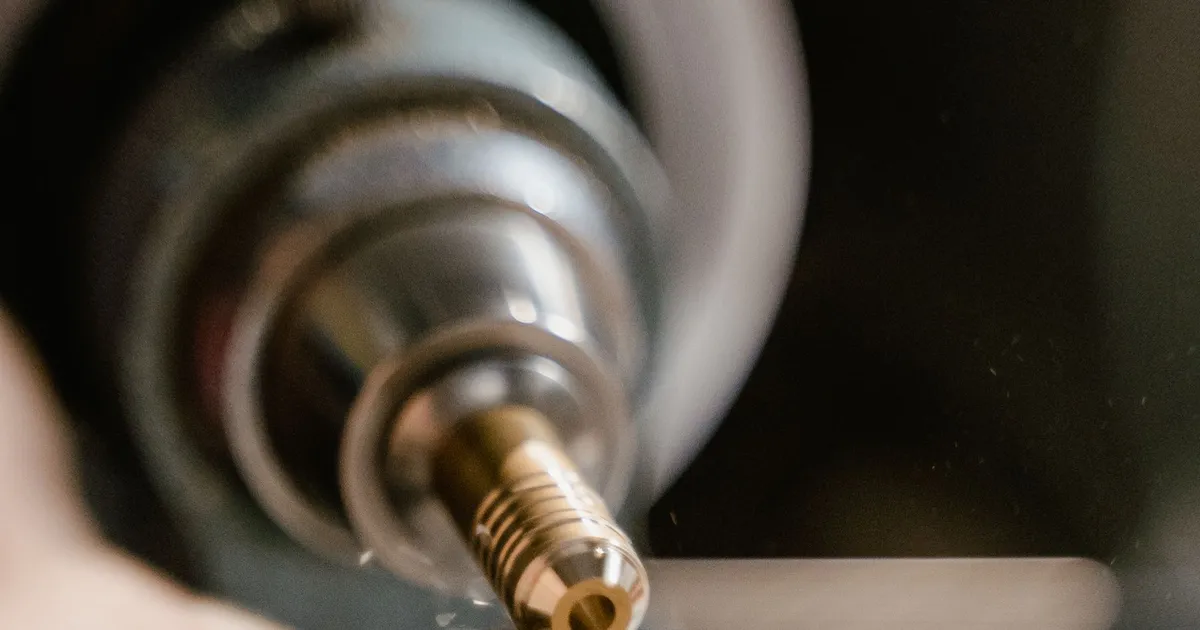
A ten-millimetre pen tip that is forty millimetres long wants to bend away from the cutting tool. A Swiss-type lathe was built to stop exactly that, and it is the machine behind most of the small round parts in the EDC world: pen tips, bit holders, pivot pins, standoffs and lanyard hardware.
How a Swiss-type lathe works
On a conventional lathe the bar is held in a chuck and the tool cuts out in free air, far from the chuck. On a Swiss-type machine the bar slides through a guide bushing and the tool cuts right at the face of that bushing. The unsupported length is only a few millimetres, so the part cannot flex much, however long it is.
The headstock moves the bar forward through the bushing a little at a time. When the front of the part is finished, a sub-spindle grabs it, the part is cut off and the back end is machined while the next part already begins on the main spindle. That overlap is why a Swiss cycle on a small part is often far shorter than the same part on a standard lathe.
Most Swiss machines also carry live tools. They can drill cross holes, mill flats and slots and cut a thread on the bar without moving the part to a second machine. For EDC parts that matters, because every extra setup is a place where concentricity is lost.
Which EDC parts suit it
The rule of thumb is a slender part with a small diameter. Typical machine capacities are about 20, 25 or 32 mm bar, and the sweet spot sits below roughly 20 mm.
- Pen tips, refill sleeves and small pen sections
- Hex bit holders and bit bodies for pocket drivers
- Pivot pins, standoffs and backspacer posts for knives
- Titanium and steel screws with a long shank
- Lanyard beads and small turned fittings
- Slim flashlight tail caps and switch parts
Parts with a big flange or a large head and a short stem do not benefit. A shop will usually run those on a conventional CNC lathe or a mill-turn machine because the guide bushing gives no advantage when the part is stubby.
What the bar stock needs
The guide bushing has a clearance of a few hundredths of a millimetre around the bar. That is why Swiss work is quoted on precision ground or cold drawn bar and not on rough hot rolled stock.
Three things to specify:
- Bar tolerance. Ground bar in an h-tolerance such as h7 is common. Ask the shop which tolerance it stocks for your alloy.
- Straightness. A bent bar chatters in the bushing and leaves a wavy surface.
- Alloy availability. Brass, stainless and aluminium ground bar are easy to buy. Titanium ground bar in small diameters exists, but it may need a lead time and a minimum quantity from the mill.
If a design uses a diameter that is not a standard bar size, the shop may have to turn the bar down first or buy the next size up. Both add cost. It pays to design the outside diameter around a common bar size and leave the shop a few tenths of a millimetre of cleanup.
What tolerances to expect
A well-tuned Swiss machine commonly holds outside diameters in the range of a few hundredths of a millimetre and repeats well across a batch. Concentricity between features turned in the same chucking is typically better than between features made on two machines. Treat these as typical figures and ask the shop what it has measured on similar parts.
| Item | Typical on a Swiss-type lathe | Ask the shop |
|---|---|---|
| Diameter tolerance on turned features | about ±0.01 to ±0.02 mm | Which gauge checks it |
| Runout between features in one cycle | about 0.01 to 0.03 mm TIR | Whether measured per batch |
| Surface finish, turned | about Ra 0.8 to 1.6 µm | Finish after bead blast or tumble |
| Length-to-diameter ratio | 10:1 and above is routine | Maximum for your alloy |
| Part diameter | up to 20 to 32 mm | Machine capacity |
Where Swiss turning does not pay
Setup is slower than on a standard lathe. A tooling plan, a guide bushing set to the bar size and a tuned program can take several hours before the first good part. For five parts that setup dominates the price. For two hundred it disappears into the unit cost.
It also does not help when the real difficulty is not slenderness. A flashlight body with a large bore and heavy walls needs a big chuck lathe. A knife scale is a milled part and never touches a lathe at all.
Cost at EDC batch sizes
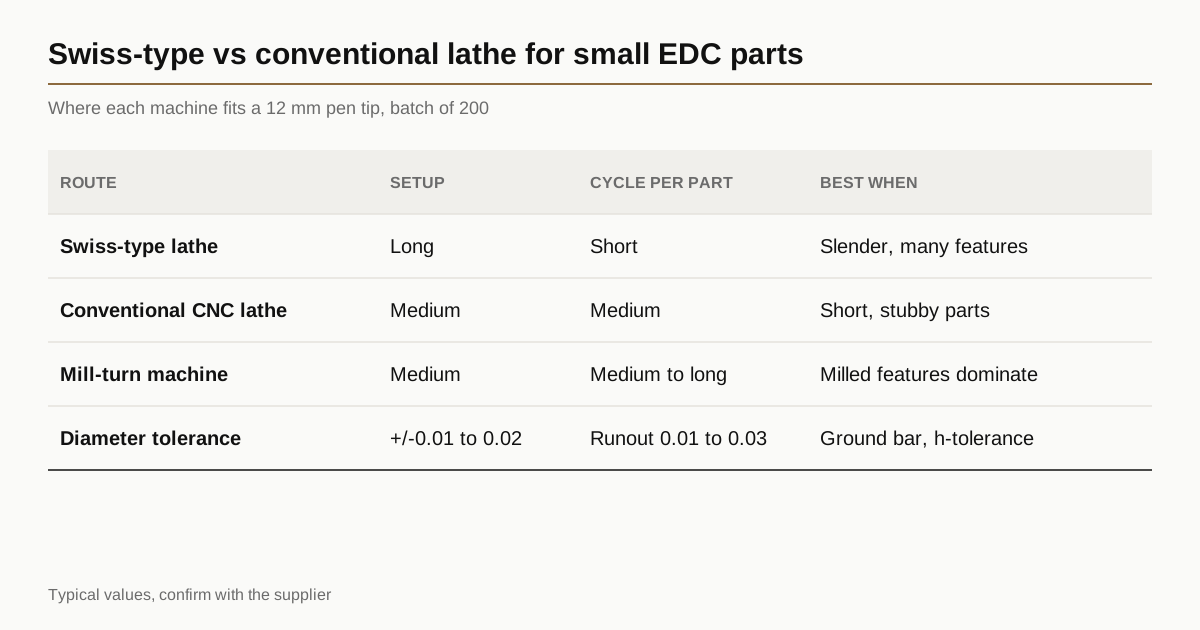
A rough way to compare options for a 12 mm pen tip in a batch of 200:
| Route | Setup | Cycle per part | Best when |
|---|---|---|---|
| Swiss-type lathe | long | short | slender, many features |
| Conventional CNC lathe | medium | medium | short, stubby parts |
| Mill-turn machine | medium | medium to long | milled features dominate |
The shops in the network that run Swiss machines usually quote a lower unit price from about a hundred parts upward. Below that, a conventional lathe with a skilled operator can be cheaper overall. Our job when we route an RFQ is to send the drawing to the right kind of machine, not to the nearest one.
Titanium on a Swiss machine
Grade 5 titanium works on Swiss machines but it is slow to cut and tough on tooling. The short unsupported length helps with chatter. Coolant pressure and chip breaking decide whether the cycle runs unattended. For a thread cut on the bar, see thread milling vs tapping small titanium threads and for the basics of the pen as a whole, the titanium pen machining guide.
What to write in the RFQ
- Drawing with the outside diameter, total length and every critical diameter marked
- Alloy, bar condition and the temper if relevant
- Batch size now and the likely reorder size
- Thread callouts, with class and whether the thread is anodized afterwards
- Cosmetic requirements on the turned surface
- Any feature that has to be made in the same chucking, such as bore and outside diameter
If the part is slender, say so and give the length-to-diameter ratio. A shop reading that will think Swiss at once. Send the drawing with those lines and the quote will arrive within 24 business hours.
FAQ
What does Swiss-type mean? It refers to the sliding headstock and guide bushing design that came from Swiss watchmaking. The name describes the machine, not where the part is made.
Is a Swiss-type lathe more accurate than a normal lathe? Not by default. It holds slender parts steadier, which helps accuracy on long thin parts. On a short part, a good conventional lathe can hold the same tolerances.
What is the smallest batch that makes sense? Many shops will run twenty to fifty parts, but the setup is spread over very few pieces. From about a hundred the unit price usually falls to a sensible level.
Can pen barrels be made on a Swiss lathe? If the barrel diameter fits the machine and the wall is thin enough to need support, yes. Larger pen barrels often go on a standard lathe with a bar feeder.
Do I need to supply the bar stock? No. The shop buys it. What you can do is name the alloy and the temper and accept a standard bar diameter near your design size.