17-4 PH stainless for clips and hardware: H900 vs H1150
17-4 PH stainless is machined soft and aged hard. H900 is strong and brittle, H1150 is tougher and softer. What the condition changes for clips, pins and bolts.
A pocket clip, a lock bar pin or a pivot bolt needs strength in a small cross section and enough corrosion resistance to survive a pocket. 17-4 PH stainless fits that brief, but it is sold and heat treated in several conditions that behave very differently. “17-4” on a drawing is not enough. The condition, H900 or H1150 or something between, is the specification that matters.
What 17-4 PH is
17-4 PH, UNS S17400, is a precipitation-hardening stainless steel with roughly 17 percent chromium, 4 percent nickel and 4 percent copper, plus a little niobium. It is martensitic, magnetic and heat treatable by a low-temperature aging step, with no quench and no high temperature distortion.
That is the key advantage. A shop machines the part in the soft solution-annealed state, called Condition A, which cuts easily. The part is then aged in a furnace at a modest temperature to reach the final strength. The aging step changes dimensions only a little and does not scale or warp the part the way a hardening quench does.
The corrosion resistance is about that of 304 stainless in many environments. It is a good choice where the part has to be both stronger than 304 and more corrosion resistant than 420 or 440.
What the H numbers mean
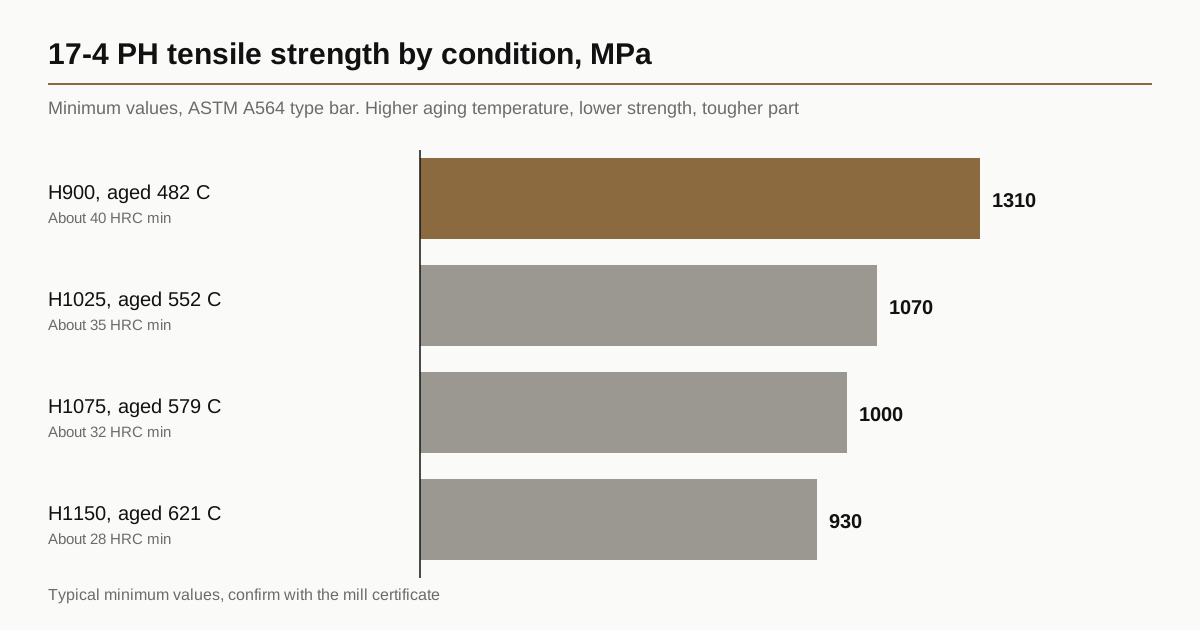
The H number is the aging temperature in degrees Fahrenheit. H900 is aged at about 900 degrees F (482 C). H1150 is aged at about 1150 degrees F (620 C). A higher aging temperature gives lower strength and hardness but better toughness and better resistance to stress corrosion.
Typical minimum values from standards such as ASTM A564 for bar are shown below. Check the current edition and the mill certificate for your lot.
| Condition | Aging temperature | Tensile strength, min | Yield strength, min | Hardness, min | Character |
|---|---|---|---|---|---|
| H900 | about 482 °C | about 1310 MPa | about 1170 MPa | about 40 HRC | strongest, least tough |
| H1025 | about 552 °C | about 1070 MPa | about 1000 MPa | about 35 HRC | balance |
| H1075 | about 579 °C | about 1000 MPa | about 860 MPa | about 32 HRC | tougher |
| H1150 | about 621 °C | about 930 MPa | about 725 MPa | about 28 HRC | toughest, most stress-corrosion resistant |
The numbers show a simple trade. H900 is a strong, springy and wear-resistant state but less forgiving in impact. H1150 gives up some strength for toughness and ductility.
Choosing for clips
A pocket clip works as a spring. It flexes every time it goes over a pocket edge. The need is a high yield strength so that it does not take a permanent set, with enough toughness to survive bends and snags.
- H900 gives the most spring and the best resistance to taking a set. It is also the condition most likely to crack if bent past its limit or if the clip has sharp corners or deep marking.
- H1075 to H1150 takes a bend better but may need a thicker section for the same spring force.
Clip geometry, thickness and radii matter as much as the alloy. Pocket clip design and spring temper covers how designers set these.
Choosing for hardware
For pins, standoffs, lock bars and pivot bolts, the choice depends on the load and the shape.
- Pivot bolts and pins that carry shear and wear: H900 or H1025 for strength and hardness.
- Fasteners with a thread and a head in a damp environment: H1025 to H1150, because high-strength material in a stressed, wet part can be more prone to cracking.
- Lock bars that see impact and spring action: a middle condition, tested.
Stainless hardware screws made from 17-4 may also gall against titanium. Use lubricant at assembly and test the pair.
Machining and size change
Machine in Condition A, or in a condition the supplier has already aged if the part geometry is simple and tolerance is loose. For parts machined in A and then aged:
- Parts shrink slightly when aged, by a few hundredths of a percent. H900 and H1150 shrink by different amounts. A shop with experience knows the figure for the alloy and the condition and may leave stock to finish after aging.
- Grind or finish-turn after aging for tight fits, such as pivot pins.
- Surface finish is easier to hold in A than in H900.
The aging step is simple, but record it: furnace temperature, time and cooling. A certificate from the heat treater is part of the batch record.
Typical order of operations for a clip
A clip is usually cut from annealed sheet or plate by laser, waterjet or wire EDM, bent to shape or machined, then aged. The order matters. Bending after aging at H900 risks cracking, so the form is made first and the part is aged in a fixture or flat if possible. After aging, the clip is cleaned, passivated and finished by bead blast or tumbling. A sample clip should be flexed several hundred times on the real knife and checked for set before the batch is released. Record the hardness of one clip per aging load, because the load, not the bar, is what sets the final condition.
Corrosion and passivation
Like other stainless steels, 17-4 benefits from passivation after machining to remove free iron from the surface. See passivation of stainless EDC parts for how it is specified and checked. Hardened 17-4 in H900 is more sensitive to hydrogen and chloride stress than the lower aging conditions, so avoid acid pickling steps that are not needed.
Comparison with other options
For small hardware, 17-4 competes with 303 or 304 (softer, cheaper), 316 (more corrosion resistant, weaker) and 420 or 440C (harder but less corrosion resistant). See stainless steels for EDC: 304, 316, 416 and 440C for how those fit. 17-4 is the pick where you want 304-level corrosion behaviour with much higher strength and easy heat treatment.
What to write in the RFQ
- Alloy and standard: 17-4 PH, UNS S17400, with the bar or sheet specification
- Final condition: H900, H1025, H1075 or H1150, with the hardness range
- Sequence: machine in Condition A, age, then finish
- Tolerances that apply after aging
- Passivation and finish
- Mill certificate and heat treatment certificate
- Clip thickness and bend radius if applicable
Send the drawing with the condition marked and the shops in the network will reply within 24 business hours.
FAQ
Is 17-4 PH magnetic? Yes. It is a martensitic stainless steel.
Can I harden 17-4 without a furnace? No. Aging needs controlled temperature and time. A heat treater does it in a furnace.
Is H900 always the best choice? No. It is the strongest but least tough. Many parts do better in H1025 or H1150.
Does 17-4 rust? It resists corrosion well, comparable to 304 in many cases, but it can stain in salt water or if passivation is skipped.
Why do shops ask when the part is aged? Because the part changes size slightly when aged, and tight fits need to be machined after aging or adjusted.