Frame lock lockbars: steel inserts, spring and heat treat
A titanium frame lock bar is a spring and a wear face at once. When a steel insert helps, which grade and hardness to specify, and how to avoid overtravel.
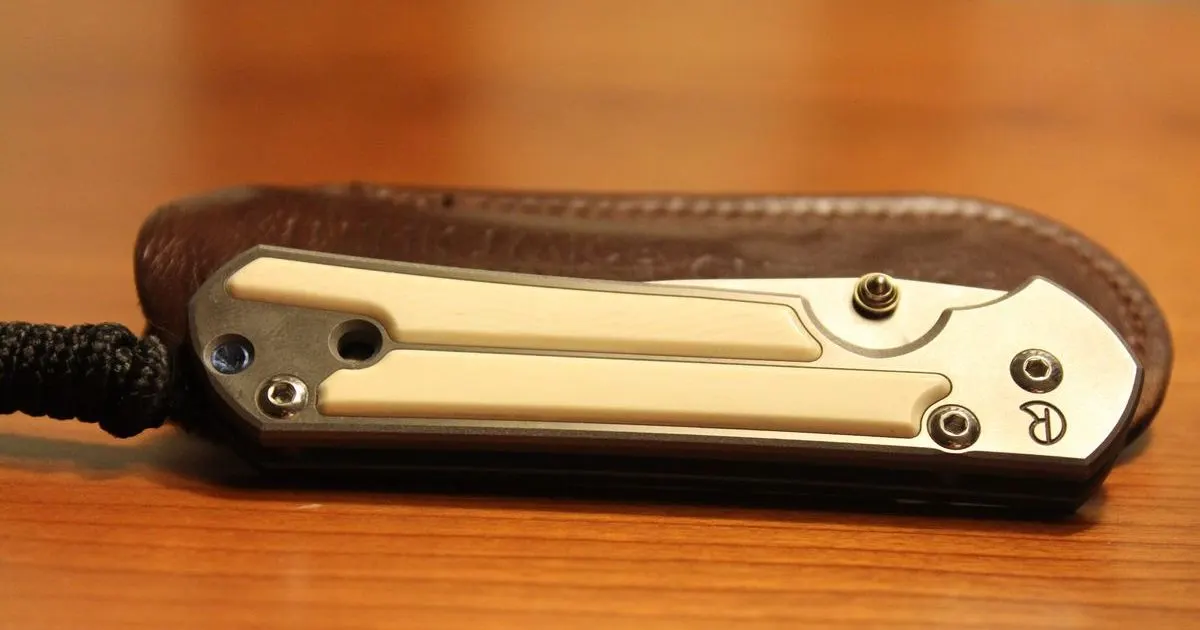
A frame lock bar does two jobs at once: it is a spring that holds the blade open, and it is a wear surface that rubs against the blade tang every time the knife opens and closes. A steel insert in the end of the bar separates those jobs, giving the wear face a hard material while the rest of the bar stays titanium. Whether you need one depends on how hard the knife will be used, how long you expect it to last and how much you want to spend on a small extra part. This guide covers what the lock does, the insert options with their hardness figures, how to avoid overtravel, and what to put on the drawing so a shop can quote the lockbar correctly.
What a frame lock asks of the material
In a frame lock the handle is the liner: the lock bar is cut from the handle itself and is spring-loaded against the back of the blade when it is open. The Sebenza entry on Wikipedia credits Chris Reeve with the layout, called the Reeve Integral Lock, in which the handle itself forms the lock bar that holds the blade open. That design puts three demands on one piece of metal:
- Springiness. The bar must flex sideways to let the tang pass, then return.
- Strength. It carries the load when the blade is pushed back toward closed.
- Wear resistance. The contact point meets a hardened blade tang thousands of times.
Grade 5 titanium (Ti-6Al-4V) is the usual choice because it springs well. The Ti-6Al-4V reference entry gives a tensile yield of about 880 to 920 MPa, a modulus of about 104 to 113 GPa and a typical minimum hardness of about 36 HRC. Springiness comes from the ratio of yield to modulus, and titanium’s is high. Hardness is the weak point. The blade steels in folding knife blade steels typically run in the high 50s to low 60s HRC, far above titanium’s 36.
What the spring can take: a first-pass number
A lockbar behaves roughly like a cantilever beam fixed at one end. Standard beam theory gives a tip deflection of F·L³ / (3·E·I) for an end load F, and a bending stress of M·c / I. For a rectangular bar of thickness t, combining the two gives the largest tip deflection that stays elastic:
δ(max) = 2 · σy · L² / (3 · E · t)
where σy is yield strength, E is modulus, L is the free length and t is the thickness in the bending direction. As an illustration, take a 40 mm free length and a 3 mm bar. With the yield and modulus ranges quoted above, the result is about 2.8 to 3.2 mm of tip movement before the bar yields. A real lockbar has a relief cut and a changing section, so this is a first-pass figure to see the scale, not a design value. It shows why pushing a lockbar well past its normal travel can leave it with a permanent set, and why some lock designs add an overtravel stop.
Why makers add steel inserts
The argument for an insert is simple: a 36 HRC bar rubs against a tang that is far harder, so over many cycles the titanium side wears and the lock-up position moves. An insert puts a harder face at the contact point. A replaceable insert has a second benefit: a worn lock can be serviced without scrapping the handle.
How much this matters in practice is disputed among makers and users. We have not found a published controlled wear test comparing insert and no-insert bars, so treat any single anecdote with care. The sensible position for a brand is to decide on use case: a light-duty EDC folder may do well without an insert, while a hard-use model or a premium line that promises long life is where an insert earns its cost.
An insert is not free of downsides. It adds a part, a pocket to machine, a fit to hold and a second material to heat treat. It also changes lock geometry, and a hard face meeting a hard tang can feel different from titanium on steel. Test it on a prototype before committing a batch.
Insert options compared
| Option | Typical hardness | Strength | Watch for |
|---|---|---|---|
| Bare titanium lock face | about 36 HRC (Ti-6Al-4V) | Simplest, one part | Wear and lock-up creep under heavy use |
| 17-4 PH, aged | H900: 40 to 47 HRC; H1150: 28 to 37 HRC (AMS 5604 sheet and plate) | Stainless, machines soft and ages with little movement | H1150 is no harder than titanium, so specify H900 or H1025 for a wear face |
| Hardened tool steel such as D2 or SKD11 | about 58 to 62 HRC | The hardest and most wear resistant | Not stainless, needs a coating or care, and grinding after heat treat |
| Hardened stainless such as 440C | about 58 to 60 HRC | Stainless and hard | Machining in the hardened state is slow and grinding is needed |
| Surface-treated titanium end | Process dependent | No extra part | Ask the shop what it can actually do and verify on a sample |
The 17-4 figures come from AMS 5604 sheet and plate tables (the bar table lists different units and is easy to misread). The D2 and 440C figures come from heat treatment for EDC parts, which also covers why a harder wear face can wear the part it bears against. 17-4 PH stainless for clips and hardware explains the aging conditions.
A useful rule of thumb is to keep the insert harder than titanium but not unnecessarily harder than the tang. A face at 58 to 62 HRC meeting a blade at 58 to 62 HRC wears both slowly, while a very hard insert against a softer tang can wear the tang first.
Overtravel and the lockbar stabilizer
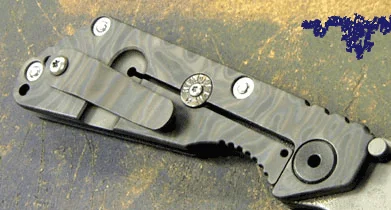
A frame lock can be pushed past its normal travel, which can weaken the spring tension. Rick Hinderer described the stabilizer he developed as a small round disc set into the handle that overlaps the lockbar, limiting how far it can move. He designed it while serving as a firefighter, after finding that heavy gloves made frame locks easy to overextend when closing, unlike liner locks where the handle limits travel. The same relief cut that lets the bar flex also creates a weak point, and the disc stops the bar flexing up under a firm grip. A stabilizer is a separate feature from an insert, though many designs use both.
What the drawing must say
The shop cannot infer lock geometry from a 3D model, so call out the following:
- Insert material and condition. “17-4 PH H900” or “D2 or SKD11, 58-62 HRC”, with the equivalent allowed.
- Pocket fit. The press, pin or screw fit for the insert and the pocket tolerance. See tolerances and fits for knife scales for how to separate critical features from the general block.
- Lock face angle and flatness. Give the angle and the tolerance, and say that it is checked after any heat treatment.
- Sequence. Machine soft, heat treat, then finish grind the face. A few hundredths of a millimetre of movement during hardening is normal, and on a lock face that is the whole tolerance.
- Surface. Edge breaks on the bar where it meets the tang, so the blade does not chatter into position.
- Inspection. Ask for a measured lock-up check on the first article, as in first-article inspection and CMM reports.
Heat treatment is usually an outside step, so add one to two weeks of lead time, as the heat treatment guide notes. Milling strategy and fixturing for the handle itself are covered in 4-axis vs 3-axis milling for titanium knife handles.
We are a sourcing desk, not a factory. We match your drawing to shops in the network that run small EDC batches and return itemised quotes; the lock design and its testing stay with you. Send the drawing and we reply within 24 business hours.
FAQ
Does a titanium frame lock need a steel insert? Not always. Many titanium lockbars work for years without one, and there is no published controlled wear test we can point to. An insert gives a harder wear face for hard-use knives and a replaceable part on some designs. Prototype both options and decide from your use case.
What hardness should a lockbar insert have? Harder than titanium, which is about 36 HRC for Ti-6Al-4V. Aged 17-4 PH H900 gives about 40 to 47 HRC, while D2 or SKD11 reach about 58 to 62 HRC. Give a range on the drawing, and match it to the tang so you do not wear the blade first.
Is 17-4 PH good for a lock insert? It is stainless, machines soft and ages with little distortion, so it suits an insert if you specify H900 or H1025. Avoid H1150, which can be no harder than the titanium bar. Compare it with hardened tool steel when wear life matters most.
What is a lockbar stabilizer? A small round disc set into the handle that overlaps the lockbar and limits how far it can move. Rick Hinderer developed it to prevent overtravel and to stop the bar flexing under a firm grip. It is separate from an insert.
How much does a steel insert add to the cost? No public price survey exists. An insert adds a small part, a pocket, a fit and possibly a heat treatment and grinding step, so ask for it as a separate line in the quote and compare. Send the same drawing to every shop.
Sources
- Wikipedia: Sebenza (Reeve Integral Lock)
- Wikipedia: Ti-6Al-4V (yield, modulus, hardness)
- Wikipedia: Euler-Bernoulli beam theory (cantilever deflection and bending stress)
- AircraftMaterials: 17-4 PH, AMS 5604 properties by condition
- Rick Hinderer Knives: The story behind the lockbar stabilizer
- Wikipedia: Folding knife (frame lock and liner lock)