Spinning tops and desk toys: balance, tips and runout
CNC spinning top manufacturing: how mass, tip contact and runout set spin time, a balance calculation you can apply, and what to put in the RFQ for a metal top.
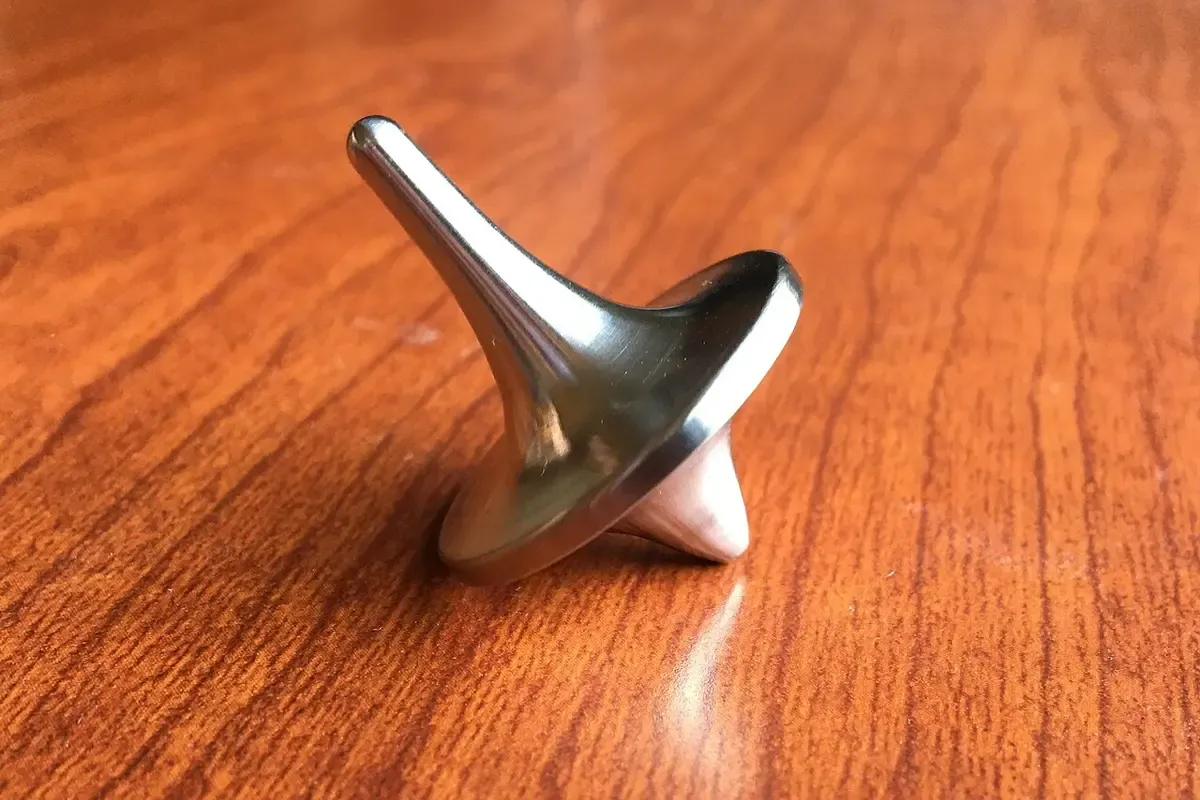
A metal spinning top is judged in seconds: how long it runs upright, and whether it wobbles before it settles. Both come from three things a shop can control. The mass and where it sits, the contact patch of the tip, and how closely the finished body runs around the axis the tip defines. This guide gives the physics in plain terms, one balance calculation you can reuse, and a list of what to put in an RFQ so a shop can quote a CNC spinning top that behaves the same from piece to piece.
What makes a top spin longer
A top stays upright because of the gyroscopic effect. After a launch it usually wobbles, then friction and torque at the tip bring it to a steady upright spin. Friction at the tip and the loss of angular momentum then slowly raise its precession until it topples. Reference descriptions of the physics give three levers that help a top spin longer:
- A larger moment of inertia. More rotational inertia means the same friction removes a smaller share of the spin per second.
- A lower centre of gravity. The body sits close to the tip, but it must not touch the ground.
- A small contact area at the tip. With a small patch and a large rotational inertia, a top can spin for tens of seconds or more on a hard surface.
One point surprises designers. Less friction does not always give a longer total spin. Less friction lengthens the time to reach a stable upright spin, and a top that is too unbalanced falls first. The design target is a stable top with a small tip contact, not a frictionless one.
Put the mass at the rim
For a solid disc about its own axis, moment of inertia is I = 1/2 m R squared, and for any body it is the sum of each mass element times the square of its distance from the axis. Radius counts twice. A heavy disc with the same mass pushed out to a rim has more inertia than a compact lump.
Material changes the mass for a given shape. Compare a plain solid disc, 30 mm diameter and 8 mm thick, using handbook densities:
| Material | Density (g/cm3) | Mass of the disc | Moment of inertia (g cm2) |
|---|---|---|---|
| Aluminium 6061 | 2.70 | 15.3 g | 17.2 |
| Titanium Ti-6Al-4V | 4.43 to 4.51 | 25.1 to 25.5 g | 28.2 to 28.7 |
| Brass | 8.4 to 8.73 | 47.5 to 49.4 g | 53.4 to 55.5 |
| Tungsten carbide | 15.6 | 88.2 g | 99.2 |
Densities are from the Wikipedia pages for each material. Mass and inertia are my arithmetic for an idealised disc, so a real top with a stem and a recess will differ. The ratio is what matters: brass gives about twice the inertia of titanium and three times that of aluminium for the same shape. That is why light-metal tops add a brass or tungsten ring at the rim. The same idea appears for spinners in fidget sliders and spinners: weight, bearings and tolerance stack. Brass brings a patina question, covered in brass, bronze and copper in EDC.
The tip decides the feel
The tip is a very small patch of contact that carries the whole top. Three decisions matter.
- Material. A hard tip resists wear. Tungsten carbide has a density of 15.6 g/cm3 and a Vickers hardness around 2600, and it is brittle enough that it can shatter under impact. A carbide point in a steel or titanium body needs a fixing method, such as brazing or bonding, that stays put when the top is dropped. Tungsten carbide glass breakers and tips covers grades and fixing.
- Radius. A sharper point cuts friction but can chip, mark the desk and wear faster. No public standard sets the right radius for a top. Ask the shop to make a few samples at two or three tip radii and spin them on your intended surface, then freeze the number.
- Coaxiality. The point must lie on the axis of the body. A tip that sits off axis by even a few hundredths of a millimetre throws the top off balance whatever the finish.
Say how the tip is finished, and whether its shape and position are measured or only inspected by eye.
Runout: how round, about which axis
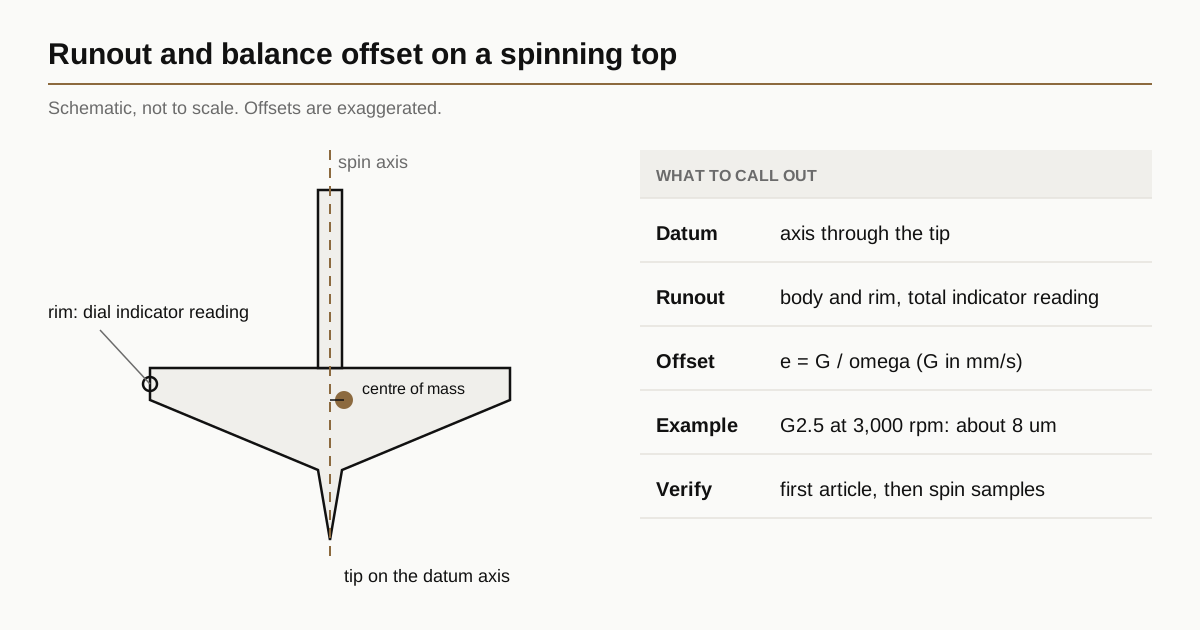
A top has no bearing, so its axis is the line through the tip. Runout is the error in how well the body rotates about that line. It is usually measured with a dial indicator against the rotating part, and total indicator reading, now often called full indicator movement, is the total measured variation including every form of error. Radial runout is an offset parallel to the axis. Axial runout is a tilt, so the error changes along the length. The two can add or partly cancel.
On a drawing, circular runout and total runout are the geometric characteristics that control this. The datum is the axis, not one face: define it from the tip end and a centre or shoulder on the other end, and check the body diameter against it.
Practice that shops use for small turned bodies is to cut every feature that matters in one setup, or between centres, so the surfaces share the same axis. Ask the shop how it holds the part, and what it measures. See Swiss-type turning for EDC pens, bits and small pins for small-diameter bar work that suits stemmed tops.
Balance: how much offset is too much
Rotating unbalance comes in several forms. Static unbalance means the inertial axis is displaced from and parallel to the rotation axis, which is common in disc-shaped rotors. Couple unbalance involves two equal forces 180 degrees apart. Dynamic unbalance combines the two and is the most common. A top is a tall disc with a stem, so it can show both.
The ISO balance grades, written G followed by a number, tie the permitted centre-of-mass offset to speed. For a rigid rotor the offset times angular speed is constant for a grade, so the allowed offset e is G divided by omega, where G is in mm per second. Here is the arithmetic at an assumed 3,000 rpm, which is a speed I chose for illustration, not a measured value for a hand-spun top:
| Grade | Allowed offset at 3,000 rpm |
|---|---|
| G1 | about 3.2 micrometres |
| G2.5 | about 8.0 micrometres |
| G6.3 | about 20 micrometres |
The G grades are written for rotors on bearings, and no standard assigns a grade to a toy top. Use them as a scale to set a target, then test spin quality on samples. Note the other lesson in the formula: the faster the top spins, the smaller the permitted offset, so the launch speed you assume sets how tight the target has to be.
A 25 g titanium top at G2.5 and 3,000 rpm has an allowed offset of about 8 micrometres, which is a residual unbalance of about 0.2 gram-millimetres. That is tight for a turned part but reachable if the body is cut in one setup and the tip is aligned after fixing.
Finish and surface
A top is held, flicked and dropped. Bead blast hides marks, polish shows every fingerprint, and anodizing adds a few micrometres that change mass and balance by a small amount. If colour matters, apply it before the final balance check. See EDC finishes: stonewash, bead blast and anodize and first-article inspection and CMM reports on a small EDC batch.
What to put in the RFQ
- Drawing with datum axis. Tip axis defined, runout and coaxiality called out for body diameter, rim and tip.
- Material and mass. Material grade, target mass with a range, and any inserts such as a brass ring or carbide tip.
- Tip. Material, radius, how it is fixed, and how much it may protrude.
- Balance target. An offset in micrometres or a G grade, and how the shop will verify it.
- Finish. Process and whether the final check is before or after finish.
- Samples. A first batch of five to ten tops spun by you before the full order.
We are a sourcing desk, not a factory. We match your drawing to shops in the network that run small EDC batches and return itemised quotes. Send the drawing and we reply within 24 business hours.
FAQ
What makes a metal spinning top spin longer? A larger moment of inertia, a lower centre of gravity, a small contact area at the tip and good balance. Mass placed at the rim helps most, because inertia grows with the square of the distance from the axis. A top that is badly out of balance falls first however good its tip.
Which metal is best for a spinning top? Brass and tungsten-loaded designs give the most inertia for a given size. Titanium gives about 60 percent more inertia than aluminium for the same shape and is lighter in the hand. Pick by feel and price, then test spin time on samples with the same tip.
What runout tolerance should a CNC top have? No public standard sets one. Start from the balance target: at G2.5 and 3,000 rpm the allowed offset is about 8 micrometres. Ask the shop what it can hold on the body diameter relative to the tip axis, and confirm on a measured first article.
Should the tip be tungsten carbide? Carbide resists wear, with a Vickers hardness around 2600, but it can chip or shatter if dropped and needs a secure fixing. A hardened metal point is more forgiving. Sample both and spin them on the surface your buyers will use.
Can a shop balance a top? Yes. Balancing means checking the centre of mass against the axis and correcting by cutting or sorting parts. A shop with a balancing setup can do this, or can hold alignment by cutting every feature in one setup. Ask how it will verify and report it.
Sources
- Wikipedia: Spinning top (stability, precession, what makes a top spin longer)
- Wikipedia: Moment of inertia (disc formula, mass distribution)
- Wikipedia: Rotating unbalance (static, couple and dynamic unbalance, ISO balance grades)
- Wikipedia: Run-out (radial and axial run-out, total indicator reading)
- Wikipedia: Geometric dimensioning and tolerancing (circular and total run-out symbols)
- Wikipedia: Tungsten carbide (density, hardness, brittleness)