Tungsten carbide glass breakers and tips: grades and fixing methods
Tungsten carbide is hard and brittle, so the grade and the way the tip is held matter more than the shape. Grades, tip geometry and press-fit, braze or bond fixing.
A small tungsten carbide tip at the end of a pen, keychain tool or pry bar is the part that does the hard work if a window has to be broken. It is also the part that most often comes loose, chips or gets specified wrongly. The carbide itself is a standard industrial material. The craft is in choosing the grade and holding it in the body.
What the material is
Tungsten carbide used for tools and tips is a cemented carbide. Fine grains of tungsten carbide are bonded with a metal binder, most often cobalt, and sintered into a dense solid. It is very hard and very heavy, with a density roughly twice that of steel.
Three features matter for tips:
- Hardness. Far above hardened steel. That is why it scratches glass and ceramic and why steel cannot easily shape it.
- Brittleness. Low toughness compared with steel. A sharp point under a side load can chip.
- Weight. A carbide tip of a few grams adds noticeable mass to a small tool.
Because carbide is so hard, it is formed in the sintered state by diamond grinding or by EDM, not by ordinary cutting tools. Most EDC makers buy standard carbide tips and balls, not custom-ground ones.
Grades
Carbide grades differ in binder content and grain size. Two broad trends:
- More binder, tougher and less hard. A higher cobalt content gives better impact resistance.
- Finer grain, harder and stronger at the edge. Fine and ultra-fine grades hold a sharper point.
Tip makers usually offer a few choices. A grade with about 6 to 10 percent cobalt is a common range for wear and impact parts. Binders based on nickel are used where corrosion resistance or low magnetism matters. The ISO 513 system groups carbide grades by application, and a supplier can map their grade to it. Check the current edition.
For a glass-breaking tip, the aim is a balance: enough hardness to hold a point and enough toughness not to chip. Ask the supplier for the grade data sheet and for a recommended grade for impact use.
Tip geometry
The shape sets how well a tip concentrates force and how likely it is to chip.
- Cone with a rounded point. The most common. A point radius of a few tenths of a millimetre resists chipping better than a needle point.
- Hemispherical or ball. Strong and forgiving. Concentrates force less than a point.
- Short and thick. A stubby tip is stronger than a long slender one. Keep the exposed length short.
- Included angle. Typically in the range of 60 to 90 degrees. Narrower is sharper and weaker.
Test several shapes on tempered glass samples if the product is sold as a rescue tool. Also check local rules for tools sold as tactical or rescue implements in each market.
Fixing methods
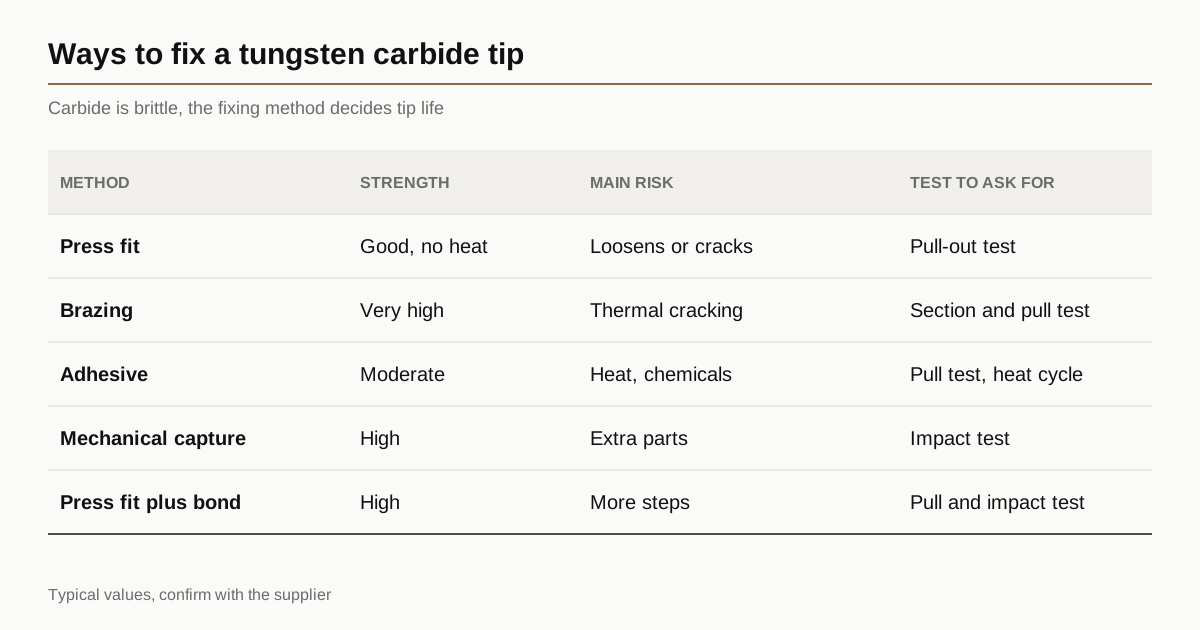
Carbide expands less than titanium or steel when heated, and it cracks if forced. The way a tip is held decides its life.
| Method | How it works | Strengths | Risks |
|---|---|---|---|
| Press fit | tip pushed into a slightly smaller pocket | no heat, simple | wrong interference loosens or cracks |
| Brazing | tip joined with filler metal in a furnace or torch | very strong joint | thermal stress, special flux, needs skill |
| Adhesive or retaining compound | tip bonded in a close-fit pocket | easy, flexible | heat and chemical limits, pull-out strength varies |
| Mechanical capture | a lip or threaded sleeve holds the tip | no bond needed | extra parts, tolerances |
| Combination | press fit plus bond | extra security | more steps |
Press fit
The pocket in the body is made a few hundredths of a millimetre smaller than the tip. The tip is then pressed in, sometimes with the body gently warmed. The right interference depends on the body material and wall thickness, and the shop sets it by testing. A titanium pocket relaxes, so a press fit that works at first can loosen with temperature cycles. Ask the shop for a pull-out test on sample parts.
Brazing
Brazing gives the strongest joint but the thermal mismatch can crack the carbide as the part cools. It needs the right filler and flux and a controlled process. It is common in carbide cutting tools but less common in EDC bodies, particularly where the body is anodized or heat sensitive.
Adhesive
A two-part epoxy or an anaerobic retaining compound in a close-fit pocket is common for pen and keychain tips. It is simple, but heat, cleaning agents or impact can weaken it. Surface preparation and glue-line thickness matter. Ask for adhesive data and a pull test.
Mechanical capture
A design where the tip sits in a pocket with a rolled or turned lip, or inside a threaded sleeve, holds it even if the glue fails. This is the most forgiving design for impact use.
What to test
- Pull-out force on samples, to a figure the brand sets.
- Impact test on samples, with a drop or a strike on a hard surface.
- Temperature cycle, such as a warm car in summer, for adhesive-fixed tips.
- Visual check for chips under a loupe after the impact test.
Treat tests as a design step and record the results. First article inspection for small batches shows how to document them.
Body material
The body that holds the tip should be stiff and thick enough to support it. Aluminium bodies can crack around a press fit. Titanium and stainless hold better. A thin pen tip wall is a poor home for a carbide point. See the titanium pen machining guide for wall and thread points that apply here too.
Cost and sourcing
Standard tips and balls are cheap from industrial suppliers and come in many sizes. Custom-ground shapes cost much more and have minimum orders. If the design can use a standard size, it is the cheaper route. Ask the shop to quote with a standard tip first.
What to write in the RFQ
- Carbide grade, or a request for the supplier’s recommendation
- Tip shape, included angle and point radius
- Tip dimensions with tolerance and the pocket dimensions
- Fixing method, with the pull-out force target
- Body material and wall thickness at the pocket
- Finish: anodize or coating before or after fitting
- Required tests on samples
Send the drawing with the tip drawing and the shops in the network will reply within 24 business hours.
FAQ
Is tungsten carbide the same as tungsten? No. It is a compound of tungsten and carbon, bonded with a metal such as cobalt. It is harder and more brittle than tungsten metal.
Can I machine carbide in a normal shop? Not with ordinary cutters once sintered. It is ground with diamond wheels or cut by EDM.
Why does my tip fall out? Wrong fit, poor surface preparation, or thermal cycles. A mechanical capture design avoids relying on glue alone.
Is a sharper tip better? Not always. A needle point chips. A small radius at the point lasts longer.
Does carbide need a coating? No. Coating is for the body, not the tip.