Fidget sliders and spinners: weight, bearings and tolerance stack
Metal fidget sliders and spinners succeed or fail on a few hundredths of a millimetre. Bearing seats, track clearance, balance and weight, with typical tolerances.
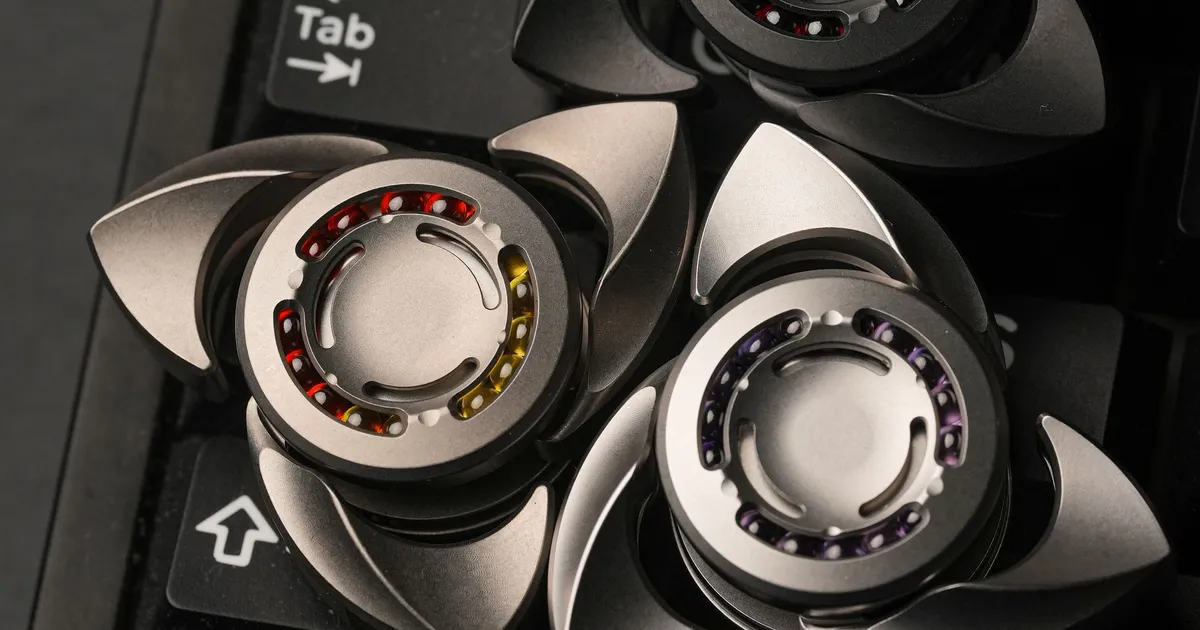
A fidget slider or spinner has no job except to feel good in the hand, and feel is a tolerance problem. A pocket that is 0.02 mm too tight kills a bearing. A track that is 0.05 mm too loose rattles. Machining these products well means thinking about the stack of dimensions, not just each feature.
Two product types, two problems
Sliders have a body with a track and a moving block. The block runs along the track with a click at each end or each step, produced by a magnet, a spring plunger or a detent ball. The critical features are the track width, the block width and the surface finish of both.
Spinners have a central bearing and arms that carry weight. The critical features are the bearing seat, the balance of the arms and the way the cover or ring clamps the bearing.
Weight and material
Weight is part of the sales story. A metal fidget tool can range from a feathery 30 g in aluminium or titanium to over 100 g in brass or copper.
| Material | Density g/cm³ | Feel | Machining |
|---|---|---|---|
| Aluminium 6061 | about 2.7 | light, warm | easy |
| Titanium Grade 5 | about 4.4 | medium, cool | slow |
| Zirconium 702 | about 6.5 | solid | slow, gummy |
| Stainless 316 | about 8.0 | heavy | medium |
| Brass C360 | about 8.5 | heavy, warm | very easy |
| Copper C110 | about 8.9 | heaviest | gummy |
Mixed designs use a light body and add weight at the rim with brass, copper or tungsten inserts. That raises spin time for a given diameter and adds parts to fit. See zirconium for EDC for a heavier alternative to titanium.
Bearings for spinners
Most metal spinners use a standard small bearing, such as the skate type 608 (8 mm bore, 22 mm outside diameter, 7 mm wide) or the smaller R188 (about 6.35 mm bore, 12.7 mm outside diameter, 4.8 mm wide). Hybrid versions with ceramic balls reduce friction and last longer.
Bearing tolerances are tight and the housing must respect them:
- Outside diameter. A standard bearing outer ring is made slightly under its nominal size, within a tight band of hundredths of a millimetre. The pocket must be made to the dimension the bearing maker recommends.
- Fit. A light press fit holds the bearing without distorting the outer ring. Too tight and the bearing runs rough or binds. Too loose and it spins in the pocket.
- Seat depth. The seat should be a few hundredths of a millimetre shorter than the bearing width so that a cover can clamp the outer ring.
- Seat flatness and squareness. A tilted seat makes the bearing run with a wobble.
If the shop does not have the bearing in hand, ask for the bearing maker’s recommended housing tolerance, or use a sample.
The tolerance stack
A stack is the sum of small dimensions that must add up to a gap or an overlap. For a spinner:
- Bearing width, from the bearing certificate
- Depth of the seat in the body
- Thickness of the cover or retaining ring
- Height of the centre cap or screw head
If the cover touches the inner ring as well as the outer ring, the bearing drags. The cover should clamp the outer ring only and clear the inner ring. A clearance of about 0.1 to 0.3 mm over the inner ring is common in designs. The stack must produce that gap even when each part is at the edge of its tolerance.
For a slider the stack is across the track. Track width, block width and any plating or anodizing all enter. A block 0.04 mm narrower than the track gives a loose feel. A block that is wider binds.
Balance
An unbalanced spinner wobbles. Balance depends on:
- Symmetry of the arms. Machined shapes must match in mass.
- Mass of inserts. Weights should be selected or ground to within a small mass range.
- Hole positions. A position error of a few hundredths of a millimetre on a heavy insert shifts the centre of mass.
A shop can weigh each insert and sort them into matched sets. Sorting costs a few minutes per part and pays back in feel. Ask the shop to state a balance target, for example within a fraction of a gram across arms.
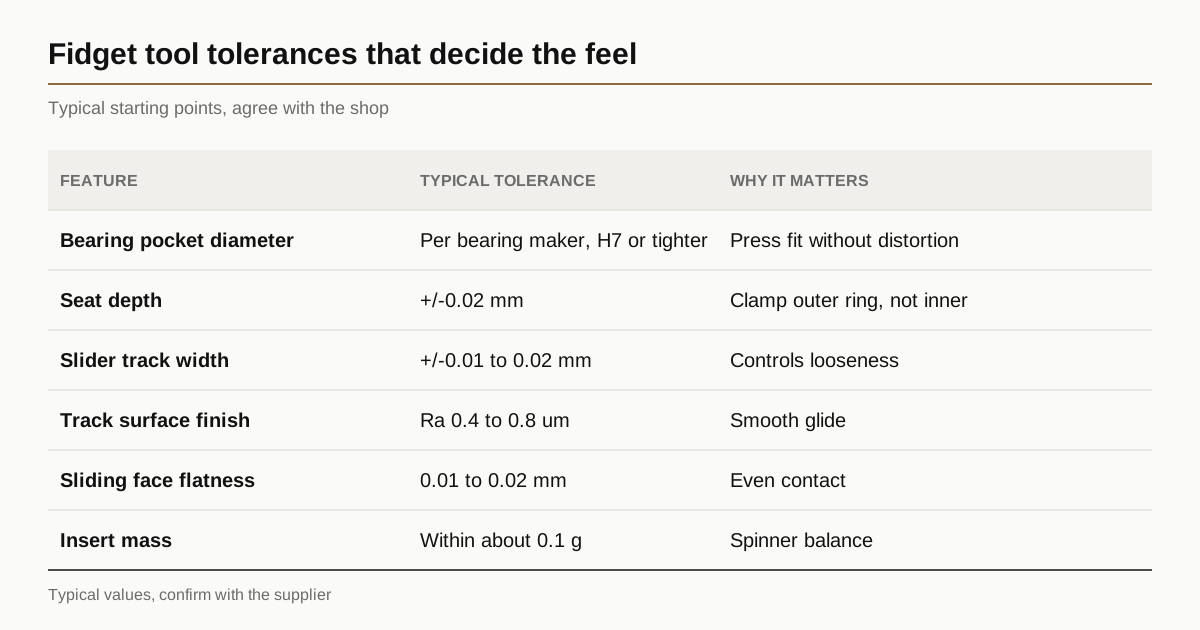
Typical tolerances
Treat these as typical starting points for discussion with the shop.
| Feature | Typical tolerance | Why |
|---|---|---|
| Bearing pocket diameter | per bearing maker, often H7 or tighter | press fit without distortion |
| Seat depth | ±0.02 mm | clamp the outer ring, not the inner |
| Slider track width | ±0.01 to ±0.02 mm | controls looseness |
| Track surface finish | about Ra 0.4 to 0.8 µm | smooth glide |
| Flatness of sliding faces | 0.01 to 0.02 mm | even contact |
| Insert mass | within about 0.1 g | balance |
Detents, magnets and springs
Sliders use clicks. Magnets are the most common source:
- Neodymium magnets are strong and small but brittle and sensitive to heat. Many grades lose strength above about 80 degrees Celsius. Do not anodize or bake the assembly with magnets inside. Fit them after finishing.
- Spring plungers give a repeatable click and are replaceable.
- Detent balls in a drilled pocket with a small spring provide a mechanical click.
The pocket for a magnet must hold it with an adhesive or a press fit and cover it with a thin wall. The wall should be thick enough to resist cracking and thin enough to keep the pull strong. Both depend on the magnet grade, so test samples.
Finish and feel
The finish decides what the hand notices.
- Bead blast gives a soft matte feel.
- Polish feels slick but shows fingerprints.
- Anodize adds colour on aluminium and titanium. The coating adds a few microns to track width. Allow for it in the stack.
- Edge breaks. Sharp edges feel cheap and sharp corners on sliding blocks can bind. See tumbling, deburring and edge breaks.
What to write in the RFQ
- Drawing with bearing seat, track and cover dimensions, plus the bearing part number
- A note on which fit is intended: press fit or slip
- Material, weight target and any inserts
- Balance requirement for spinners
- Finish and whether magnets are fitted before or after it
- A first batch of samples for feel testing
Send the drawing and the shops in the network will reply within 24 business hours. For the ground rules on tolerances in small batches, low MOQ CNC and what small batches cost is a useful companion.
FAQ
Which bearing is most common in metal spinners? The 608 skate bearing and the smaller R188. Both are widely available, including hybrid ceramic versions.
Why does my spinner wobble? Usually unbalanced mass or a tilted bearing seat. Check arm weights and seat squareness.
Can magnets be anodized in place? No. Heat and chemicals harm them. Fit magnets after finishing.
What is the best material for a slider? Titanium, brass and copper are popular. The choice is about weight, feel and finish.
How many samples should I order first? Three to five, to test fit, feel and balance before a batch.