Shipping knife blades across borders: customs and carriers
How to ship knife blades internationally: US switchblade rules, UK banned knives, postal and courier limits, HTS lines and the paperwork that avoids a seizure.
Whether you can ship knife blades across a border depends on three separate layers: the import law of the destination, the rules of the carrier or post office you use, and how honestly the paperwork describes the goods. In the United States, ordinary folding-knife blades and parts are admissible, while automatic-opening knives and parts that convert easily into one are not. The UK keeps a list of banned knife types. Postal services and couriers add their own limits on top. This guide walks through each layer so a knife brand can move blades, blanks and finished knives without a seizure. It is not legal advice, so have a customs broker confirm your specific product before the first shipment.
Who ships what, and where the risk sits
A small EDC brand moves bladed goods in three directions, and each has a different risk:
- Shop to brand. Machined scales, handles, hardware and sometimes blade blanks or finished blades travel from the shop to the importer. The importer of record is the party who answers to customs. Who the importer of record is on a small order is set out in importer of record for a small EDC order.
- Brand to customers. Finished knives go to buyers in other countries, often by post or express courier. This is where carrier rules and destination bans matter most, because the parcel reaches a consumer.
- Samples and prototypes. A single knife in a small parcel is still a knife to a customs officer. The same rules apply, with less margin for a vague description.
A blade blank with no edge, a ground blade and a finished folder are different things to a customs officer, and an automatic knife is a different thing again. Describe each one for what it is.
United States: what CBP admits and what it forfeits
The federal Switchblade Knife Act, 15 U.S.C. 1241 to 1245, defines a switchblade as a knife whose blade opens automatically by hand pressure on a button or device in the handle, or by inertia, gravity or both. Introducing one into interstate commerce is punishable by a fine of up to $2,000 or imprisonment of up to five years, or both. CBP applies the act at the border through 19 CFR 12.95 to 12.97.
CBP’s definition goes further than the statute’s wording on the item itself. It covers an imported knife, knife component or class of knife, including gravity, butterfly, balisong and ballistic types, that:
- opens automatically as described above,
- can be converted to do so with “insignificant preliminary preparation”, meaning ordinary tools and a short time, such as adjusting a blade heel or relieving a binding part,
- is an unassembled kit or bladeless handle that becomes an automatic knife once assembled with added parts, or
- has a detachable blade propelled by a spring mechanism.
Under 19 CFR 12.97, imports of switchblades other than those permitted by 15 U.S.C. 1244 are contrary to law and subject to seizure and forfeiture under 19 U.S.C. 1595a(c). The statutory exceptions are narrow: common carriers in the ordinary course of business, military contracts and personnel, a one-armed person carrying a knife with a blade of three inches or less, and assisted-opening knives, where a spring or detent biases the blade toward closed and the user must apply hand, wrist or arm force to overcome it.
What is admissible is spelled out in 19 CFR 12.96. Jackknives, standard pocketknives, scout knives, special-purpose knives and knives with single-edge utilitarian blades such as clip, pen and razor styles enter unrestricted, provided they are not switchblades as entered. Certain fixed-blade articles, such as sheath knives and machetes, fall outside the federal act, though state or city law can still apply after release.
For a brand, two practical points follow:
- Components count. A handle with an internal spring cavity or a kit that makes an automatic knife can be treated as the knife. If a design is anywhere near automatic, spring-assisted or “easy to convert”, get a broker or customs attorney opinion before ordering parts across a border.
- Assisted-opening is a design question, not a label. The statute’s exception turns on how much force the user must apply. CBP can and does rule on individual designs, so ask for the ruling history of a similar product rather than relying on a marketing name.
The UK and other destinations
Import controls are set by the destination, so the same parcel can be legal in one country and a criminal matter in another. GOV.UK’s guidance on offensive weapons lists knives that are illegal to import, sell, hire, lend, give or possess in private unless an exemption applies: butterfly knives, disguised knives, flick and gravity knives, stealth knives, zombie knives, cyclone or spiral knives, belt buckle knives, push daggers and sword-sticks, plus swords with a curved blade over 50 cm. Stealth knives may be imported if they are for domestic, food or toy use. Goods that fail the rules are liable to forfeiture and seizure by Border Force, and an importer can be arrested and prosecuted, with a maximum sentence of up to ten years. HMRC makes the final decision on a specific item.
Other countries restrict knives as well. A consumer shipping guide from Stamps.com names Denmark, Uganda, Japan and the UK as destinations that explicitly prohibit certain knife types in the mail, without saying which types. Treat that as a prompt to check, not as a list. The customs authority of each destination market is the source, and a brand selling into several countries should keep one short page per market with the rule, the date it was checked and who confirmed it.
Post and carriers: three separate rule sets
National post. USPS Publication 52 treats sharp instruments under section 44. Switchblades, as defined there, are mailable only to specific categories of addressee, mainly government supply and procurement officers, and a mailer may be asked to verify the recipient. Mailable sharp items must be packed in a strong container, with an inner and outer container recommended and enough cushioning that points and edges cannot cut through. For a switchblade, nothing on the outside may indicate the contents. For international mail, the International Mail Manual says some knives and sharp instruments may be mailed only to certain countries under the conditions in the Individual Country Listings, so a domestic acceptance does not carry over.
Express couriers. Each courier, and often each service and country within a courier, has its own written list of restricted goods. This article does not quote them because they change and differ by lane. Before the first shipment, ask the courier’s sales contact in writing whether bladed goods are accepted on your origin and destination pair, which services, and with what declaration. Keep the reply with the shipment file.
Freight forwarders and consolidators. They act under the carrier’s rules and add their own. A forwarder that accepts the booking without reading the invoice has not approved the goods.
Paperwork that matches the goods
Customs outcomes are decided by what the documents say, so the description, classification and value must agree with the parcel.
| Document field | What to put | What goes wrong |
|---|---|---|
| Description | “Folding knife blade, stainless steel, unfinished” or “titanium knife scale, machined”, not “metal parts” | Vague or false wording triggers inspection and can look like concealment |
| HS or HTS number | The line your broker assigns, with the country of origin | A wrong line changes duty and can hide a restricted item |
| Value | Price paid, including setup or tooling lines where they belong in value | A low invoice to cut duty is a separate offence |
| Country of origin | Where the part was made, stated on the invoice | A shop address is not the origin test, see the tariff guide |
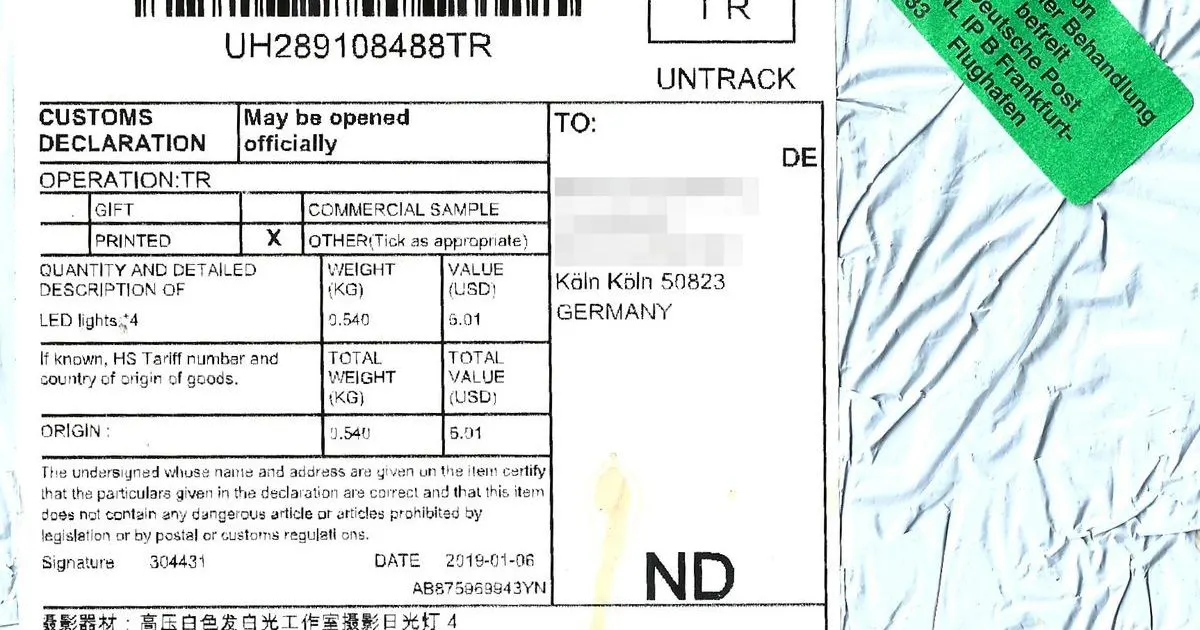
| Contents note on a parcel | Honest and specific, matching the invoice | A packet labelled “gift” with a knife inside is the usual seizure story |
The USITC schedule has a line for blades of knives. For example, HTS 8211.94.10.00 covers blades for knives having fixed blades, at 0.16 cents each plus 2.2% general duty, and 8211.94.50.00 covers other knife blades, at 1 cent each plus 5.4%, as of October 2026. Additional duties can stack on top, and a steel blade may also fall under the metals rules. The current stacking is covered in US tariffs on Vietnam-made EDC parts in 2026, and duty and fees feed the numbers in landed cost of CNC EDC parts.
A pre-shipment checklist
- Classify the item: blank, ground blade, fixed blade, manual folder, assisted-opening, automatic.
- Check the destination’s import law for that class, and the transit countries if the route is not direct.
- Get the carrier’s written acceptance for that class on that lane.
- Match description, HTS line, origin and value on every document.
- Pack to the post’s standard: strong box, inner and outer packing, cushioning so edges cannot cut through.
- Ask the broker whether any state or local rule applies after release, since the federal rules do not cover everything.
- Keep the file: invoice, packing list, carrier reply, broker note.
For a crowdfunded drop, add these steps to the budget before the campaign goes live, as covered in EDC Kickstarter manufacturing: prototype to shipped batch. A blade restriction found after backers are counted is a refund problem, not a paperwork problem.
The wider import route is in our guide to importing EDC parts from Vietnam.
We are a sourcing desk, not a factory. We match your drawing to shops in the network that run small EDC batches and return itemised quotes with the delivery term stated; classification, import law and carrier acceptance remain with you and your broker. Send the drawing and we reply within 24 business hours. For how those quotes are compared, see what buyers compare in an EDC quote.
FAQ
Can I ship a folding knife blade internationally? Often yes, but not everywhere and not with every carrier. The destination’s import law, the carrier’s written rules and the type of knife all decide it. Ordinary manual folders and plain blades are admissible in the US, while some countries ban whole categories. Confirm destination and carrier before booking.
Are assisted-opening knives treated as switchblades in the US? The statute exempts knives where a spring or detent biases the blade closed and the user must apply hand, wrist or arm force to overcome it. CBP also looks at whether a knife can be converted to open automatically with insignificant preparation. Ask a broker about your specific design.
Which HTS code applies to knife blades? Heading 8211 covers knives with cutting blades, and subheading 8211.94 covers blades. As of October 2026 the USITC lists 8211.94.10.00 for fixed-blade knives and 8211.94.50.00 for other blades. Your broker assigns the line for the actual part, and additional duties may apply on top.
Can I mail knives with USPS? Mailable sharp items need strong packaging with cushioning. Switchblades are mailable only to listed government categories, and international knife mail depends on the Individual Country Listings. Check Publication 52 and the International Mail Manual for the current text before sending.
What happens if customs finds an unlisted or banned knife? In the US, a switchblade import not permitted by statute is subject to seizure and forfeiture. In the UK, goods can be seized by Border Force and the importer can be prosecuted. A truthful, specific description does not make a banned item legal, but a vague one makes an inspection more likely.
Sources
- 15 U.S.C. 1241: Definitions (switchblade knife)
- 15 U.S.C. 1242: Introduction, manufacture for introduction, transportation, or distribution
- 15 U.S.C. 1244: Exceptions
- 19 CFR 12.95: Definitions, 12.96 and 12.97
- USPS Publication 52, 442: Mailability of switchblade knives and 443: Packaging and marking
- USPS International Mail Manual, 137: Firearms, knives and sharp instruments
- GOV.UK: Guns, knives, swords and other offensive weapons, UK border control
- U.S. International Trade Commission: Harmonized Tariff Schedule
- Stamps.com: USPS rules for mailing knives (directional)