Keychain tools and one-piece multi-tools: blanking vs CNC at 500 pcs
A flat keychain tool can be stamped, laser cut or milled. At 500 pieces the cheapest route is rarely the one with a tooling bill. Break-even maths and tolerances.
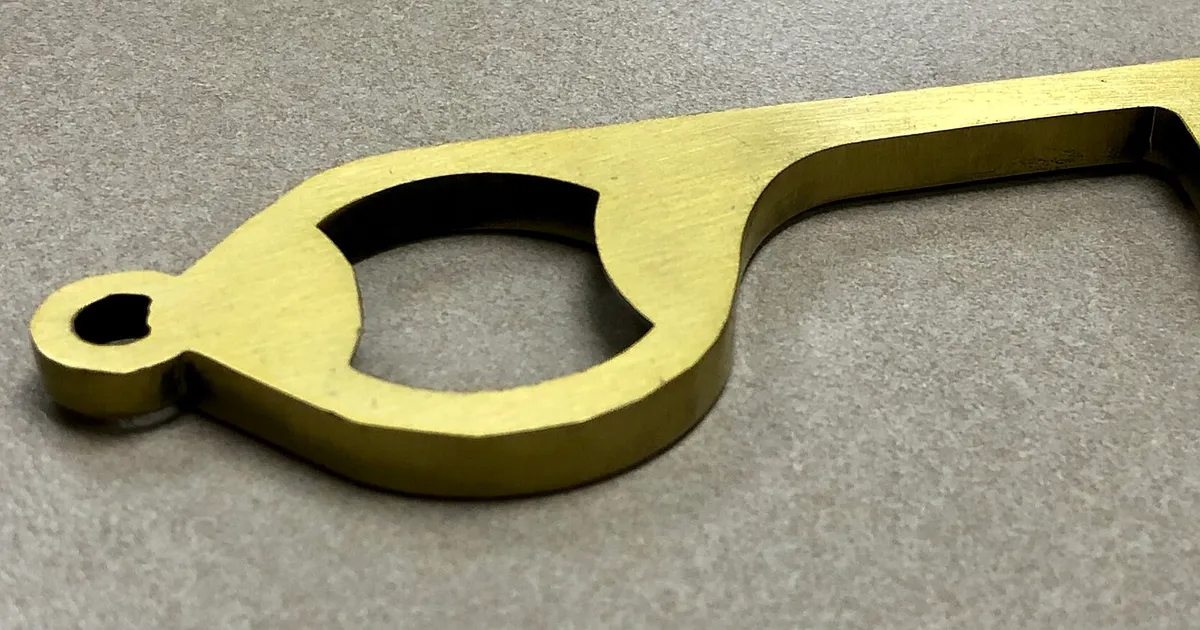
A flat keychain tool is a single piece of metal with a hole for a ring and a few cut-outs for opening, prying or turning a screw. Because it is flat, it can be made three ways: stamped in a die, cut by laser or waterjet, or milled on a CNC machine. The right choice at 500 pieces is often not the one that looks cheapest at 50,000.
The three routes
Stamping or blanking. A hardened die cuts the profile from a strip in one press stroke. A progressive die can punch holes, trim the outline and form features in stations. It is fast, around a part per second, and the unit cost is very low. The tool is a one-off cost that can run from a few thousand to well over ten thousand US dollars, depending on complexity and thickness.
Laser or waterjet cutting. A numerically controlled beam or jet cuts the profile from plate. No tooling, quick programming, any shape. Per-part time is seconds to a minute. Edges need finishing. Laser leaves a heat-affected edge, waterjet leaves a rough, slightly tapered edge.
CNC milling. A milling machine cuts the profile, chamfers and pockets from plate or bar. Most flexible and best for 3D features, controlled edge breaks and tight tolerances. Slowest per part, often several minutes.
A fourth route, wire EDM, cuts the profile of a stack of plates very accurately and burr-free. It suits harder materials and small batches. It is slower than laser for simple shapes.
Why 500 pieces is awkward
Stamping wants tens of thousands. CNC milling suits tens. Five hundred sits in between, and the answer depends on the design.
A simple break-even calculation helps. Divide the tooling cost by the saving per part:
break-even quantity = tooling cost ÷ (cost per part by the alternative − cost per part by stamping)
The numbers below are illustrative and not a quote.
| Route | Tooling | Cost per part | Notes |
|---|---|---|---|
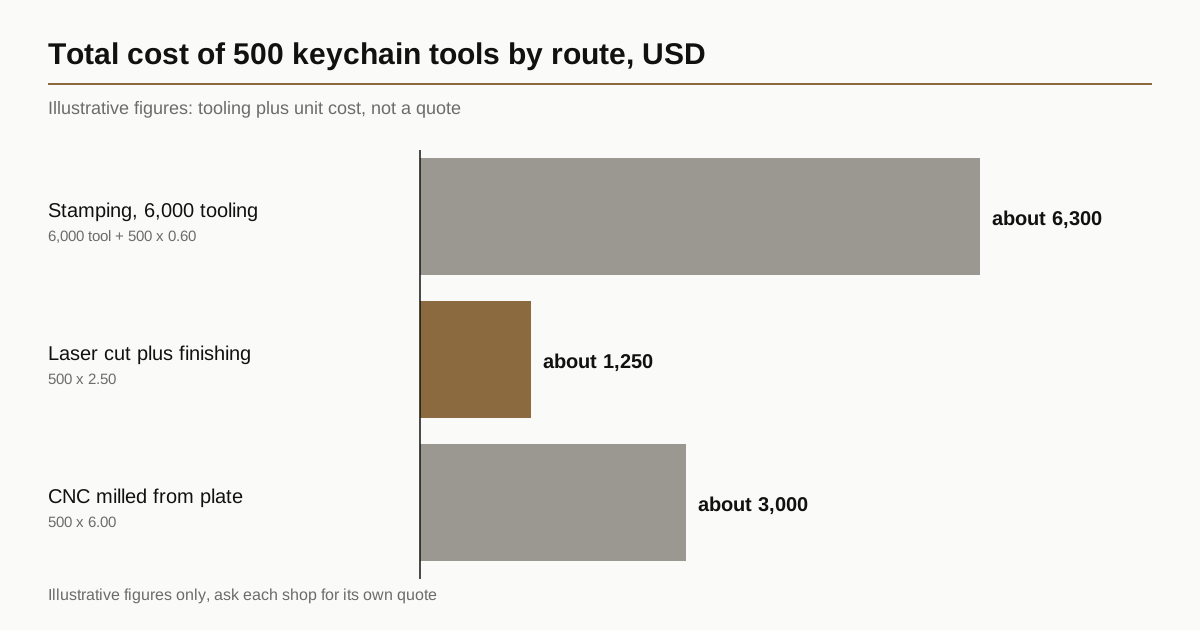
| Stamping, progressive die | about 6,000 USD | about 0.60 USD | needs sheet thickness within the press limit |
| Laser cut plus light finishing | none | about 2.50 USD | edges deburred |
| CNC milled from plate | fixture only | about 6 USD | full control of edges and chamfers |
With these figures, stamping saves 1.90 USD per part against laser cutting. The break-even is 6,000 ÷ 1.90, or about 3,160 pieces. Against CNC milling it saves 5.40 USD and breaks even near 1,110 pieces. At 500 pieces, neither break-even is reached, so stamping loses on total cost. Real shops will quote their own figures, but the pattern holds.
When stamping still makes sense
- You expect volume soon. If the design is final and reorders of several thousand are planned, tooling pays back.
- The part is thin. Sheet below about 2 to 3 mm blanks easily. Thick titanium does not.
- The material is a soft metal such as brass or aluminium. Dies last longer.
- The edge quality allows it. A stamped edge has a rolled-over zone, a clean shear band and a fracture band, plus a small burr. A deburring step is usually required.
Stamping steel or titanium thicker than about 3 mm is hard on tools. Fine blanking gives cleaner edges on thicker stock, but the presses and dies are costlier again.
Laser and waterjet in practice
For a 500-piece run, a cut blank with a CNC finishing step often wins.
- Cut the profile with 0.2 to 0.3 mm of stock left.
- Mill the edge and chamfers in one quick setup, or tumble for a soft edge.
- Machine details such as hex sockets or bottle-opener edges on the mill.
Titanium laser cut with the wrong gas leaves a brittle surface layer, so ask for waterjet or machine the edge. Titanium pry bars: profile, chamfer and finish covers the same cutting issue.
Tolerances by route
Typical figures for sheet or plate in the range of 2 to 4 mm thick. They vary with material and equipment.
| Route | Profile tolerance | Edge condition | Burr |
|---|---|---|---|
| Stamping | ±0.05 to ±0.10 mm | rollover and fracture band | small, needs removal |
| Laser | ±0.10 mm | heat-affected, slight taper | dross on some metals |
| Waterjet | ±0.10 to ±0.20 mm | rough, tapered | little |
| CNC milling | ±0.02 to ±0.05 mm | clean, chamfer in program | very small |
| Wire EDM | ±0.01 to ±0.02 mm | smooth, recast layer | none |
Materials
- Titanium Grade 5. Light and strong. Best by laser or waterjet plus CNC edge work. See Grade 2 vs Grade 5.
- Brass. Warm colour, easy to cut and stamp.
- Stainless 304 or 17-4. Tough. Check 17-4 PH conditions if the tool is hardened.
- Aluminium 6061. Light and easy to anodize, soft for a tool tip.
- Tool steel. Cut annealed, hardened after, then ground.
Finishing
The finishing steps often cost as much as the cutting. Bead blast or tumble to break edges, anodize aluminium or titanium for colour, and mark with a laser if branding is required. See laser marking vs engraving vs etching for marking options, and stonewash, bead blast and anodize for surfaces.
The decision at 500 pieces
A simple rule many buyers use:
- Under 200 pieces: CNC milling or laser plus CNC finishing.
- 200 to 2,000 pieces: laser or waterjet plus finishing, with CNC for details.
- Above 2,000 pieces and a frozen design: quote stamping.
Treat this as a guide, because thickness, material and edge needs can move a part from one band to another. Ask for quotes in two routes and compare total landed cost, not just the unit price. Low MOQ CNC and what small batches cost explains how setup affects the unit price.
What to write in the RFQ
- Drawing as DXF and PDF, with material and thickness
- Quantities now and at reorder, 500 and 2,000 for example
- Edge requirement: sharp, chamfered or rounded
- Tolerances on the key features, such as hole and tool openings
- Finish and marking
- A request for quotes in two routes, or the shop’s recommended route
- Tooling ownership, if a die is quoted
Send the drawing and the shops in the network will reply within 24 business hours with each route priced.
FAQ
Is stamping always cheaper per part? Yes at high volume, but the tool cost must be paid back. At 500 pieces it usually is not.
Can a stamped tool be made from titanium? Thin titanium can be blanked, but thick titanium is hard on dies. Many makers choose laser or waterjet for titanium.
Who owns the die? It depends on the agreement. Ask in writing. NDA, IP and tooling ownership covers the terms.
What file format is best? A DXF for the outline plus a dimensioned PDF.
Do I need a prototype before a batch? Yes. Ten pieces by CNC or laser let you check the feel and the openings.