Bolt-action pens: cam paths, refill fit and clip mounting
A bolt-action pen has a slot, a cam and a refill that must clear them all. Where the tolerances sit, how to avoid galling and what to test on the first prototypes.
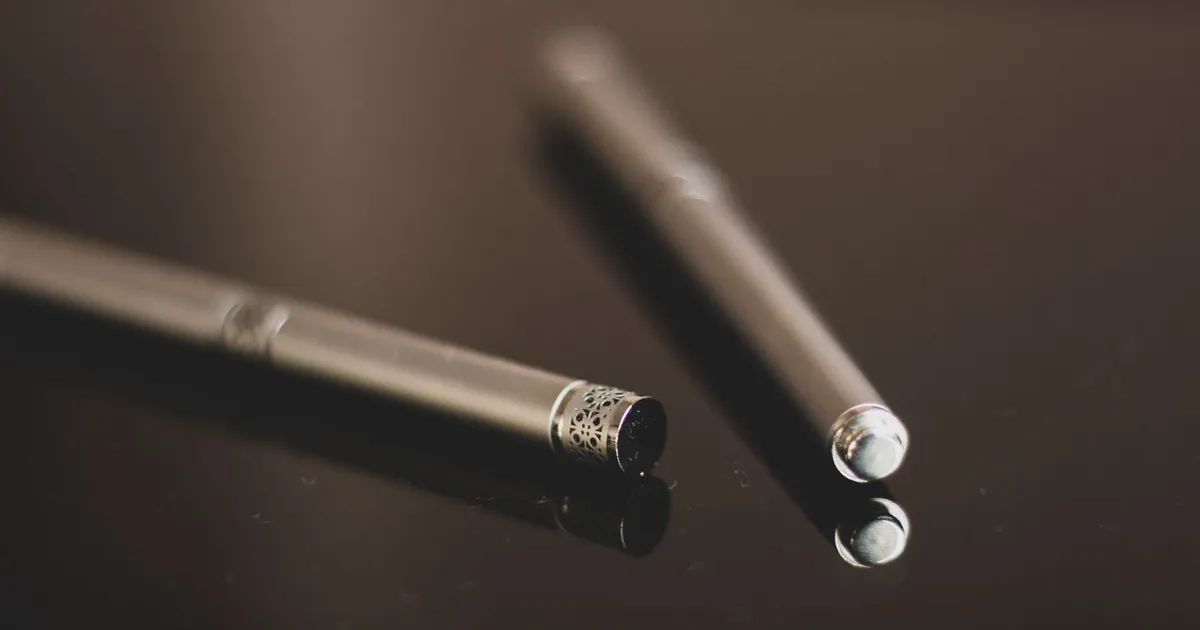
A bolt-action pen replaces the click or the twist with a sliding lever that moves the refill in and out through a slot in the barrel. It is a small mechanism, three or four parts in a tube, and it fails in specific ways: the bolt sticks, the refill rattles, the tip does not clear the nose or the clip hole breaks into the slot. Each of these traces back to a few dimensions.
How the mechanism works
The usual design has a barrel with a slot. Inside the barrel is a carrier that holds the refill, with a bolt, a pin or a lever that sticks out through the slot. A spring pushes the carrier toward the retracted position.
To write, the user pushes the bolt along the slot. At the end of the slot, a short side section, often an L shape, holds the bolt against the spring. The refill tip is now out of the nose. To retract, the user lifts the bolt out of the side notch and the spring pulls the carrier back.
Variants use a helical cam instead of an L slot. The user slides the bolt and it rotates as it follows the helix. Cam paths feel more mechanical but are harder to machine and measure.
The refill decides the geometry
Start with the refill. Refill formats differ in length, barrel diameter and tip shape. Parker-style refills, the Pilot G2 format and others are not interchangeable. Obtain real samples of the refill the pen will use and measure them. Do not rely on a catalogue number.
Key refill dimensions:
- Length of the whole refill
- Barrel diameter, which sets the bore
- Tip diameter and shape, which sets the nose opening
- Back end, where the carrier or the spring seats
In practice the stack along the length is: carrier length plus refill length minus nose depth, to set how far the tip projects when out and how far it sits back when retracted. Typical tip travel is in the range of 8 to 12 mm between the two positions. State the extended and retracted tip positions on the drawing.
Fits and clearances
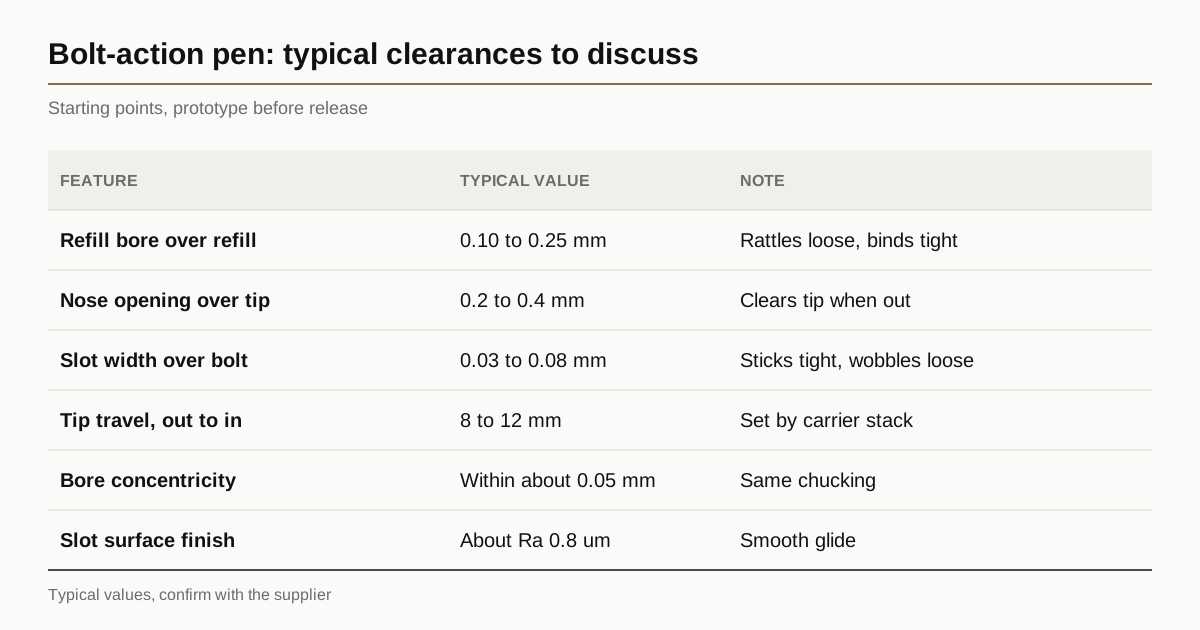
Clearance numbers vary with design. As typical starting points to discuss with the shop:
| Feature | Typical value | Note |
|---|---|---|
| Refill bore over refill diameter | 0.10 to 0.25 mm clearance | rattles if loose, binds if tight |
| Nose opening over tip | 0.2 to 0.4 mm clearance | clears the tip when out |
| Slot width over bolt | 0.03 to 0.08 mm clearance | too tight sticks, too loose wobbles |
| Slot length | stroke plus bolt width | stops set by the ends |
| Bore concentricity | within about 0.05 mm | see the titanium pen guide |
| Surface finish in slot | about Ra 0.8 µm | smooth glide |
These are sample figures. The pen’s feel depends on the whole stack, so prototype first.
Cutting the slot and the cam
The slot is milled with a small end mill, often 2 to 3 mm in diameter. On a mill-turn machine the barrel is clamped and indexed, and the slot is cut along its length and around the L section. Points to specify:
- Slot width and tolerance, as above.
- Corner radii at the L turn. The end mill radius sets the corner, so the pin must be smaller.
- Edge chamfer on the slot, to make the bolt glide and to avoid sharp edges on the barrel surface.
- Burr removal inside the bore along the slot, where a burr can catch the carrier.
A slot weakens a thin barrel. A 1 mm wall with a long slot can flex or crack under a hand squeeze. Many designs add a sleeve or choose a thicker wall at the slot zone. Grade 9 titanium tubing covers wall options.
For helical cams, the cutter follows a spiral at a defined lead angle. A 4-axis or mill-turn machine is needed, and the program must check cutter clearance. The cam profile should be a smooth curve without an abrupt start, or the bolt will feel notchy.
Materials and galling
The bolt and the slot rub against each other thousands of times. Pairs that gall are the main cause of sticky pens.
- Titanium bolt in titanium slot galls. Avoid it, or coat one part.
- Stainless steel bolt against titanium or aluminium is a safer pair.
- Brass or bronze slider runs smoothly on most materials but wears faster and adds weight.
- DLC or PVD on the bolt reduces wear. See PVD and DLC coatings for how it is specified.
- Anodize on the barrel face inside the slot adds hardness on aluminium and titanium, but thickness must be allowed for in the slot width.
A light grease or dry lubricant at assembly helps. The first prototypes should run several thousand cycles before the design is released.
Clip mounting
The clip must not collide with the slot. Plan its position early.
- Clip screw hole should sit away from the slot by at least a wall thickness or two.
- Thread depth in a thin wall is limited. Use a short screw or a thickened boss.
- Clip and bolt overlap. On a pen with a slot along the top, the clip often sits opposite or at an angle.
- Clip material and tension affect wear on the barrel. See pocket clip design and spring temper.
If the clip is a separate piece, set its position with a flat or an alignment pin so it does not rotate.
Refill retention and rattles
A loose refill rattles and sounds cheap. Solutions:
- A soft insert or O-ring that grips the refill gently.
- A spring seat that preloads the refill end.
- A tight bore section near the tip, only a few hundredths of a millimetre larger than the refill.
Test the sound by shaking the pen and by writing a few lines.
Prototypes and tests
Order at least three prototypes. Test:
- Cycle test. Move the bolt 5,000 times and check for wear or looseness.
- Refill swap. Change the refill ten times to see whether it is easy.
- Drop test. A short drop onto a hard floor in each orientation.
- Pocket test. Carry it for a week.
First article inspection for small batches explains how to document the measurements. For general pen advice, the titanium pen machining guide is a good starting point.
What to write in the RFQ
- Drawing with the extended and retracted tip positions and the refill model
- Slot width, length and corner radius with tolerances
- Bore diameter and concentricity target
- Bolt, spring and clip materials
- Finish, coating and where it applies
- Number of prototypes and cycle testing
Send the drawing and the shops in the network will reply within 24 business hours.
FAQ
Which refill is best for a bolt-action pen? The one you can obtain reliably in your markets. Parker-style and Pilot G2 formats are common. Measure real samples.
Why does my bolt stick? Galling, a burr in the slot or too little clearance. Check material pairing and deburr the slot.
Can a bolt-action pen be made from aluminium? Yes. Anodize the slot and use a stainless bolt for good wear.
How long should the slot be? Stroke plus the bolt width, with a margin of a millimetre or so. The refill travel sets it.
Is a cam path better than an L slot? It feels different and costs more. An L slot is simpler and easier to inspect.