Grade 9 titanium tubing for pens and lights: when it beats bar
Boring a pen barrel from solid titanium bar turns most of the metal into chips. Grade 9 tube starts hollow. Where tube wins, where bar still does and what to check.
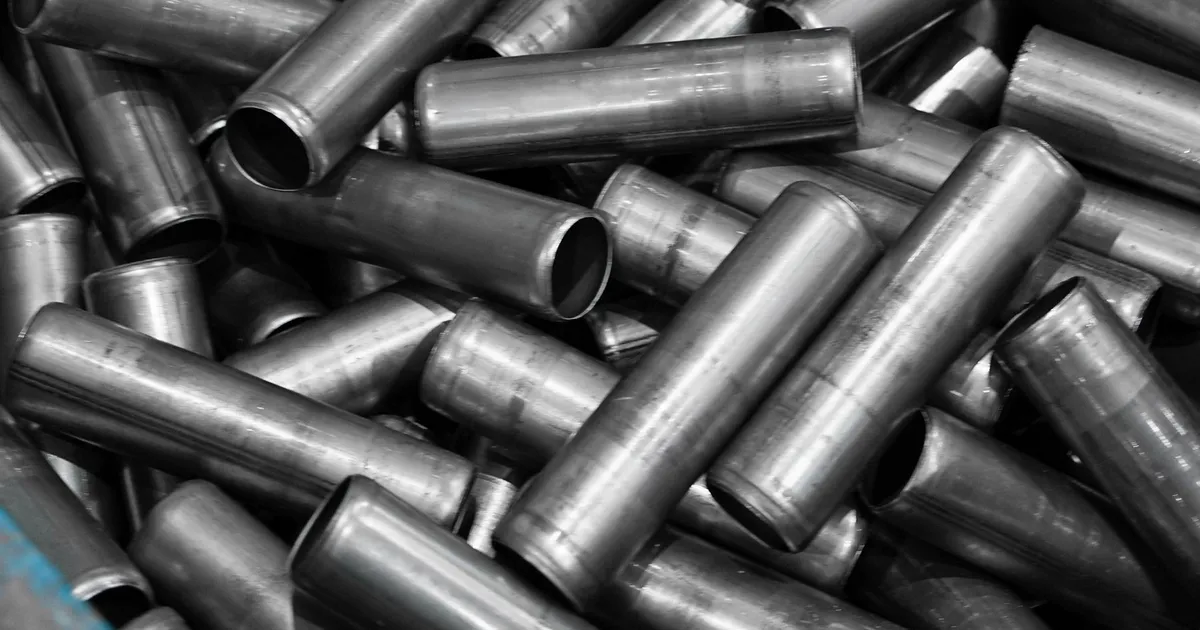
A titanium pen barrel has a wall about a millimetre thick. Make it from solid bar and more than three quarters of the bar leaves as chips. Make it from tube and the hole is already there. For slim, long, hollow parts, Grade 9 titanium tubing is often the better starting point, and it is also a strong alloy in its own right.
What Grade 9 is
Grade 9 titanium is Ti-3Al-2.5V, an alloy with about 3 percent aluminium and 2.5 percent vanadium. It sits between commercially pure Grade 2 and Grade 5 (Ti-6Al-4V) in strength. It is known for good cold formability and weldability, which is why it is the standard alloy for bicycle tubing and for aerospace hydraulic lines.
Typical tube is made seamless or welded and drawn, often to the requirements of a standard such as ASTM B338, and it is sold by outside diameter and wall thickness. Check the standard and the condition on the mill certificate for the batch you buy.
In practical terms for EDC:
- Stronger than Grade 2, so a thin wall holds its shape better.
- Softer and easier to machine than Grade 5, with less tool wear.
- Takes anodizing, with colours close to other titanium grades. A test piece is still wise.
- Good fatigue behaviour for threads and clips attached to a thin wall.
When tube beats bar
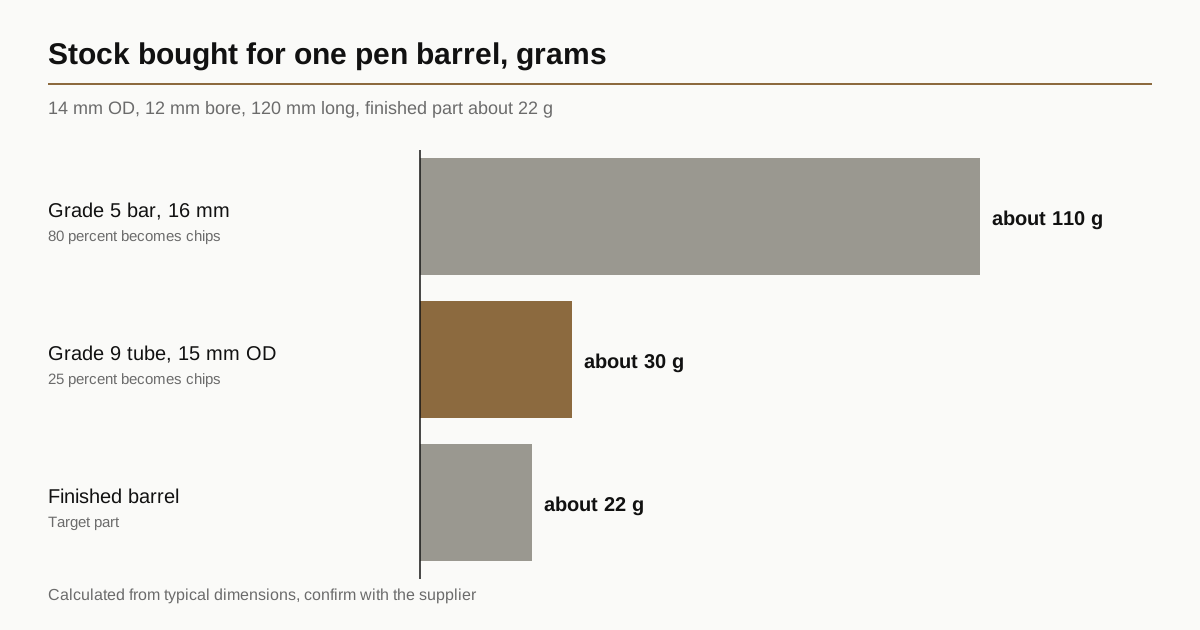
The case for tube is simple arithmetic. Take a pen barrel 14 mm outside diameter, 12 mm bore and 120 mm long.
| Route | Stock bought | Finished part | Material removed | Typical machining |
|---|---|---|---|---|
| Grade 5 bar, 16 mm | about 110 g | about 22 g | about 80 percent | deep drill, bore, long cycle |
| Grade 9 tube, 15 mm OD, 1.25 mm wall | about 30 g | about 22 g | about 25 percent | turn OD, face, thread |
| Grade 2 tube, similar size | about 30 g | about 22 g | about 25 percent | turn OD, face, thread |
Figures are calculated from typical dimensions and are only a guide. They show why tube wins on weight bought and on time: no deep hole to drill, no long boring bar chattering inside a titanium wall.
Tube also wins on:
- Straightness of bore. A drawn tube has a consistent hole. A deep drilled hole in bar can wander.
- Chip handling. Long stringy titanium chips from boring tangle. Tube turning is cleaner.
- Cost on long, slim parts. The longer the part relative to its diameter, the greater the advantage.
When bar still wins
- Thick walls. If the finished wall is 3 mm or more, tube may not be available or may cost more than bar.
- Blind ends and internal features. A part with a bottom, an internal step or a thread inside the bore starts from bar, or from tube with a plug welded or pressed in.
- Odd diameters. Tube comes in standard sizes. If the design needs a size that is not stocked, the shop has to buy the next size up and turn down.
- Very small batches. Minimum order quantities for tube may be higher than for bar.
- Concentric bore and outside. A bored bar can hold bore and OD concentric to a few hundredths of a millimetre. Tube wall thickness varies, so the OD turned on tube may not be concentric with the original bore. For most pens and lights the inside is hidden and does not matter. If it does, specify it.
Wall thickness and tolerances
Tube is sold with tolerances on OD, wall and straightness. A typical drawn tube has a wall tolerance in the range of several percent of the wall. When the outer surface is turned, the wall of the finished part follows the inner bore, which may be off-centre.
Plan for these:
- Turning allowance. Order tube with an outside diameter about 0.5 to 1 mm over the finished size to leave cleanup stock.
- Wall at threads. A thread cut into a 1 mm wall leaves little material. Keep thread depth low and consider a thickened end made from a bar insert.
- Straightness. Ask for a straightness figure per metre and check it on first articles.
Joints and added parts
A pen barrel often needs a thickened end for a thread. Common solutions:
- Machined from heavier tube with a thicker wall locally, if the tube is available.
- A pressed or bonded insert made from bar.
- A welded joint. Grade 9 welds well with inert gas shielding. Welding is a specialist step. Ask the shop if it has the capability and what the heat-affected zone looks like after anodizing.
If you thread titanium on titanium, galling is a risk. See Grade 2 vs Grade 5 and the titanium pen machining guide for how designers deal with it.
Flashlight bodies
Light bodies are a natural fit for tube when the wall is thin and the part is long. The head and tail ends usually need thicker material for threads and O-ring grooves. A common design is a tube body with threaded end rings made from bar and fixed to the body. That adds assembly steps, so compare it with a bored bar body at the quantity you need.
A practical way to compare quotes
Ask for the quote in both forms on the first run. The difference shows up in three lines: the material cost, the machining time and the scrap allowance. For a slim pen barrel the tube quote is often lower on all three. For a thick-walled light body the bar quote may win. Keep the better route and write it into the drawing notes so the reorder follows it.
Sourcing points
- Stock sizes. Ask the shop which diameters it can buy. A change of a millimetre in OD can move a tube from stock to special order.
- Condition. Cold worked and stress relieved, or annealed. This changes strength and machinability.
- Certificates. Mill certificate with heat number, chemistry and mechanical values.
- Lead time. Tube can have a longer lead time than bar for small orders.
What to write in the RFQ
- Finished OD, wall and length, with a note that tube is acceptable
- Whether the inside is cosmetic or hidden
- Thread positions and depths in the wall
- Grade and condition, with a request for the mill certificate
- Anodize or finish after machining
- Batch size and expected reorders
Send the drawing with both bar and tube options marked acceptable, and the shops in the network will reply within 24 business hours with the lower cost route.
FAQ
Is Grade 9 the same as Grade 5? No. Grade 9 has less aluminium and vanadium. It is easier to form and weld but lower in strength than Grade 5.
Can Grade 9 tube be anodized? Yes. Colours are similar to other titanium. Always test a sample.
Do I lose strength using tube instead of bar? The tube alloy has its own strength. For a pen barrel the wall thickness matters more than the alloy.
Why do some shops prefer bar? Familiar stock, no minimum order issues, and better control of bore concentricity.
Can I mix tube bodies and bar end caps? Yes. Many designs do. The joint needs a fit and a retention method, so ask the shop to propose one.