Timascus and Mokuti: sourcing layered titanium for EDC builds
Layered titanium gives each handle a one-off pattern. How blanks are bought and machined, why pattern depth moves with thickness and what to ask a maker before ordering.
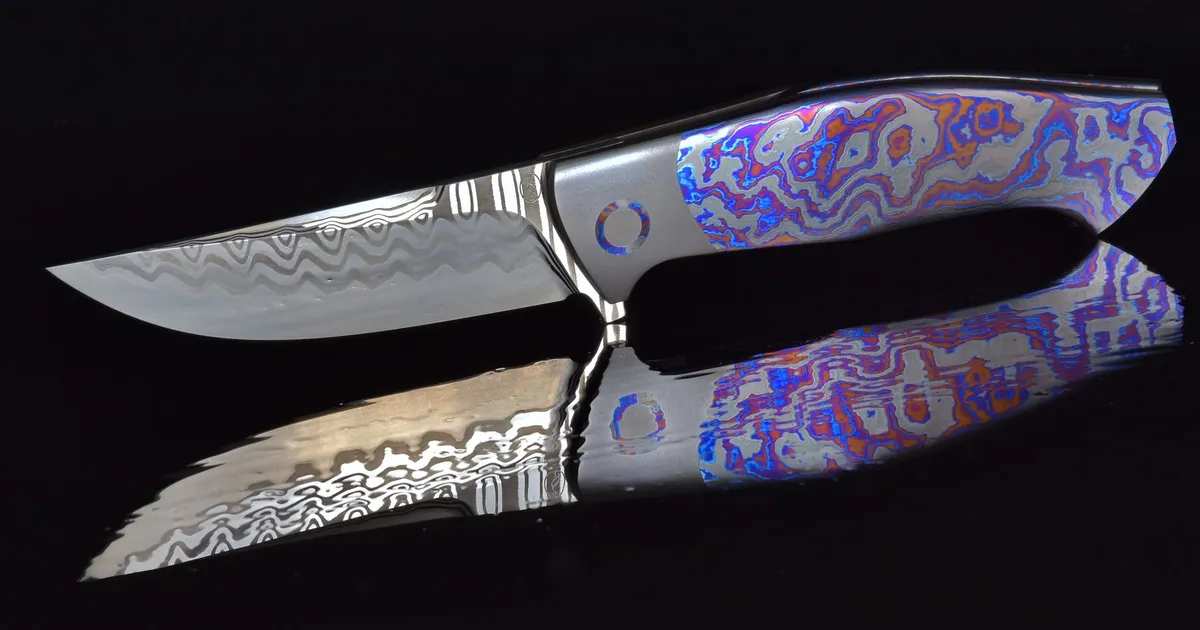
A knife handle with swirling blue, purple and gold lines looks like nothing else on the market. Most of these patterns come from layered titanium, sold under names such as Timascus and Mokuti. Sourcing it is different from sourcing plain titanium plate: you buy a pattern, not a grade, and the pattern is easy to destroy in machining.
What layered titanium is
Layered titanium follows the idea of Damascus steel and Japanese mokume-gane. Sheets of titanium and titanium alloys are stacked, bonded under heat and pressure into one solid block, and then forged, rolled, twisted or ground to bring up a pattern. Because different titanium alloys take different colours when anodized, the pattern appears as bands of colour after the finish.
Names such as Timascus and Mokuti are used by particular makers and may be registered marks. They are not universal material grades. When you order, ask what the layers are and how they are bonded, not just the name. Two billets with the same label can be made from different alloys and behave differently.
How blanks are bought
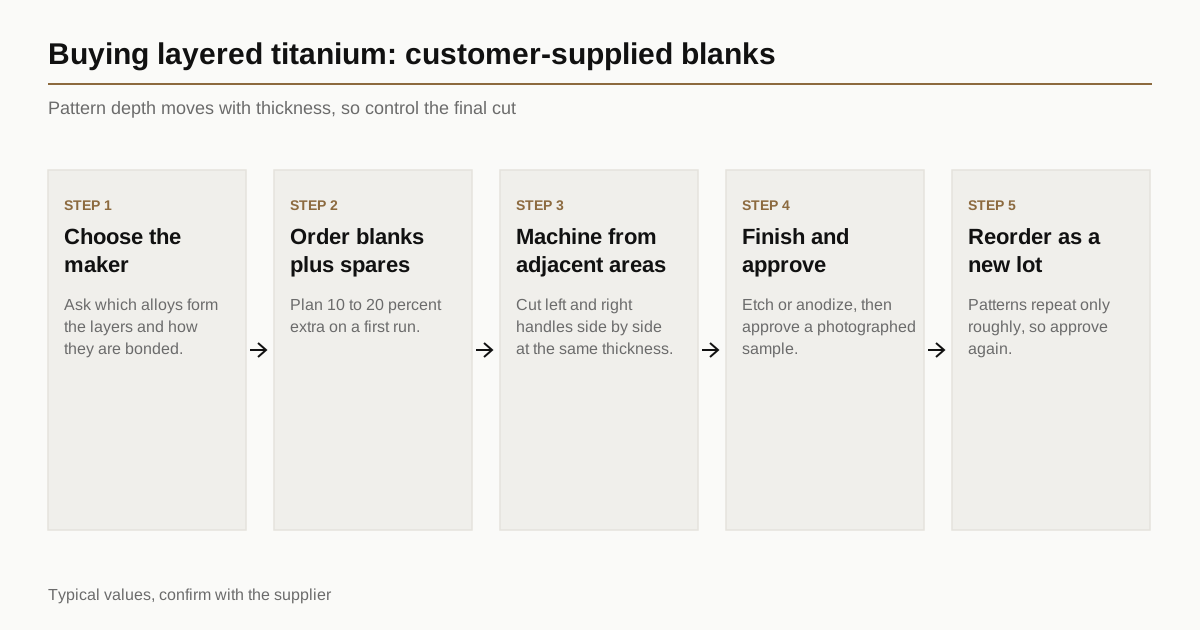
Most EDC makers buy ready-made plate or billets from a specialist maker and have a machine shop cut parts from them. The model is usually customer-supplied material:
- The brand buys the blanks and ships them to the shop.
- The shop machines parts from them and returns the parts and the offcuts.
- The brand pays for machining and shipping, not for the material.
This puts the material risk with the brand and protects the shop from a very expensive scrap. It also means the shop will ask for extra blanks, because mistakes cannot be replaced from stock. A rough rule used by shops is 10 to 20 percent spares on a first run.
Alternatively, a shop with a supplier relationship may buy the blanks for you and add a handling fee. Ask for the cost of material as a separate line.
Why pattern depth moves with thickness
This is the technical point that catches new buyers. In a layered block, the pattern runs through the thickness. Removing material from the face changes which layers are exposed, so the pattern at the surface moves as you cut. A handle machined to 3.0 mm may look different from the same plate at 3.4 mm.
For a pair of handles that must match:
- Cut left and right from adjacent areas of the same plate.
- Control final thickness tightly and state the tolerance. A few hundredths of a millimetre can change the look.
- Choose the side that will show. The pattern on the face machined last is the one the customer sees.
- Keep the same order of operations for every part.
If the design has a contoured surface, the pattern changes across the face. That can be attractive, but it should be approved on a sample, not discovered on the production run.
Machining behaviour
Layered titanium machines like titanium, with extras:
- Mixed layers cut differently. Hard and soft layers load the tool unevenly and wear the edge faster than plain Grade 5.
- Bonded interfaces can hide defects. A poorly bonded layer can lift or open under cutting forces.
- Heat matters. Excess heat can tint the surface and affect the colour after anodizing.
Shops usually run the same practice as for titanium, with sharp tools and steady coolant, and inspect the first cut face for voids. Titanium Grade 2 vs Grade 5 explains how the base alloys differ.
Finishing and colour
Finish decides the look more than machining does.
- Etching. Many layered billets are etched to raise the contrast between alloys. Ask whether the maker etches the blank or expects you to.
- Anodizing. Different alloys take different colours at the same voltage. A voltage chart is a guide, not a promise. See titanium anodizing colours and voltage.
- Bead blast or tumbling. These soften the pattern if overdone. Test on a sample.
- Clear coating. Some makers add a clear coat for scratch resistance. It changes the feel and cannot be reversed.
Every billet is unique. Colour and pattern vary from billet to billet and sometimes across one plate. Agree a range of acceptable variation, with photos, before production. The cosmetic grade approach in cosmetic inspection for EDC parts applies here.
What to ask a maker
| Question | Why it matters | Typical answer to look for |
|---|---|---|
| What alloys form the layers? | affects strength and colour | named alloys, not only a brand |
| How are layers bonded? | affects voids and delamination | diffusion bonding or forging, with process notes |
| Plate thickness and tolerance? | sets pattern depth | stated in mm with a tolerance |
| Can you cut a sample? | checks the interior pattern | yes, from the same lot |
| Lot traceability? | for reorders and complaints | lot number on each blank |
| Lead time for a reorder? | patterns do not repeat exactly | weeks, with a note on variation |
Quantities and cost
The material is expensive compared with plain titanium plate, and the price is often quoted by the blank, not by weight. For a first run, order the blanks and a handful of spares and treat the pattern as a limited edition. A repeat run will look similar but not identical, because the pattern is made by hand or by controlled forging steps that vary. Brands that sell a pattern as a signature should tell customers that each piece is individual.
Claims to avoid
Do not call a material by a trademark name if you cannot show the supply chain. Do not state strength figures for a layered billet without a test report. Describe what you can prove: the alloys, the bonding method and the finish.
What to write in the RFQ
- Who supplies the blanks, or the request that the shop sources them
- Blank size, thickness and tolerance
- Spare count and what happens to offcuts
- Final thickness tolerance and which face is the visible one
- Finish: etch, anodize, bead blast or clear coat
- Left and right pairing from adjacent areas
- Approval step with a photographed sample
Send the drawing with the blank dimensions and the shops in the network will reply within 24 business hours.
FAQ
Is Timascus stronger than Grade 5 titanium? Not by default. Strength depends on the alloys and bonding. Ask for test data before making any claim.
Why do two handles from the same plate look different? The pattern moves with depth and position. Cutting them from adjacent areas at the same thickness reduces the difference.
Can a shop buy the blanks for me? Often yes, with a handling fee. Many brands prefer to buy blanks themselves to control the pattern.
Does anodizing work on layered titanium? Yes, and it is how the colours appear. The results vary by alloy mix and voltage.
Can I get the same pattern again later? Only roughly. Treat each lot as a new run and approve a sample.